
FTA Audit Triggers UAE: What Puts You at Risk
 August 25, 2026
11 min read
August 25, 2026
11 min read
What Triggers an FTA Corporate Tax Audit in the UAE?
FTA audit triggers UAE businesses worry about usually aren’t random bad luck. Since the Federal Tax Authority shifted to a risk-based audit model, selection follows patterns — specific inconsistencies, red flags, and data mismatches that push a business’s risk score up. Understanding those patterns is the difference between an audit notice that feels like an ambush and one you saw coming with time to prepare.
The FTA carried out roughly 93,000 inspection visits in 2024 alone, a 135% jump from the year before, and enforcement has only intensified since. With corporate tax and VAT data now cross-referenced automatically through EmaraTax, a business no longer needs to do anything dishonest to get flagged — inconsistent numbers across two separate filings can be enough on their own.
This guide walks through the specific patterns that raise audit risk, what the FTA actually does once a business is flagged, and the practical steps that keep a business off the list in the first place — before a notice ever lands in the inbox.
Quick Answer: The most common FTA audit triggers in the UAE are mismatches between VAT and corporate tax turnover figures, sudden or unexplained swings in revenue or profit, consistent losses while sector peers report profits, frequent or large VAT refund claims, repeated late or amended filings, and related-party transactions without proper transfer pricing documentation. The FTA uses a risk-based scoring model, not random selection, so businesses with clean, reconciled records across VAT and corporate tax face meaningfully lower audit risk.
Table of Contents
SEO & Publishing Metadata………………………………………………………………………………… 1
Table of Contents…………………………………………………………………………………………… 1
1. What an FTA Audit Trigger Actually Means…………………………………………………….. 1
2. Why FTA Audit Activity Has Increased So Sharply…………………………………………….. 1
3. The Single Biggest Trigger: VAT-to-Corporate-Tax Mismatches…………………………… 1
4. Financial Pattern Red Flags………………………………………………………………………….. 1
5. Filing Behaviour Red Flags……………………………………………………………………………. 1
6. VAT-Specific Triggers Worth Knowing……………………………………………………………. 1
7. Industry and Structure-Specific Risk………………………………………………………………. 1
8. What Happens Once a Business Is Flagged……………………………………………………… 1
9. The Extended Audit Window You Should Know About……………………………………… 1
10. How to Reduce Your Audit Risk Proactively…………………………………………………… 1
11. A Worked Example: How a Mismatch Becomes a Notice…………………………………. 1
12. Why Partner With Alya Auditors…………………………………………………………………. 1
Image Suggestions (For Publishing)…………………………………………………………………… 1
Internal Linking Suggestions (For Publishing)……………………………………………………… 1
Frequently Asked Questions……………………………………………………………………………. 1
What is the most common FTA audit trigger in the UAE?………………………………….. 1
Does an FTA audit mean my business did something wrong?…………………………….. 1
How long can the FTA go back when auditing a business?…………………………………. 1
What’s the difference between a desk review and a field audit?………………………… 1
Can a business reduce its FTA audit risk?……………………………………………………….. 1
Are certain industries more likely to be audited?…………………………………………….. 1
How quickly should a business respond to an FTA audit notice?…………………………. 1
Can Alya Auditors help reduce my business’s audit risk?…………………………………… 1
Conclusion……………………………………………………………………………………………………. 1
Talk to Alya Auditors………………………………………………………………………………………. 1
1. What an FTA Audit Trigger Actually Means
An FTA audit trigger is a pattern, inconsistency, or data point in a business’s tax filings that raises its risk score under the FTA’s risk-based selection model. The Federal Tax Authority operates a structured framework — reportedly aligned with ISO 31000 risk management standards — that scores every registered taxable person against multiple indicators drawn from filing history, industry classification, and cross-referenced data.
- Audits are risk-driven, not random, under the FTA’s current compliance strategy
- Every registrant is scored against filing patterns, declared turnover, industry, and historical compliance behaviour
- A higher risk score increases audit probability, but doesn’t automatically mean wrongdoing
- Most audits start as a desk-based review and only escalate to a full field audit if early findings warrant it
Being flagged for review is not the same as being accused of anything. It simply means your filing data crossed a threshold the FTA’s systems are built to notice.
2. Why FTA Audit Activity Has Increased So Sharply
VAT has been part of the UAE tax system since 2018, giving the FTA years to mature its audit framework. Corporate tax is newer — the first filing season for calendar-year businesses closed in September 2025 — but the FTA has moved quickly to apply the same risk-based discipline to it.
Because VAT and corporate tax share the same underlying procedural law, the FTA can now cross-reference both data sets for the same business. A discrepancy that once might have gone unnoticed in an isolated VAT return is now visible the moment it doesn’t reconcile with a corporate tax filing covering the same period.
This shift matters most for businesses that treated VAT and corporate tax as two separate compliance exercises, handled by different people or at different times, without ever checking that the two sets of numbers actually agree with each other.
3. The Single Biggest Trigger: VAT-to-Corporate-Tax Mismatches
Multiple independent tax advisories agree on this as the most commonly cited red flag in 2026: when a business’s declared VAT taxable supplies don’t reconcile with the revenue reported on its corporate tax return for the same period, the FTA’s systems flag the gap automatically.
This isn’t a manual, occasional check. Filings submitted through the FTA’s EmaraTax portal are increasingly cross-verified in near real time, which means a mismatch is far more likely to surface quickly than it would have during the early years of VAT.
A business doesn’t need to have done anything dishonest for this to happen. Timing differences, classification errors, or simple reporting inconsistencies between the two filings are enough to trigger a request for clarification.
4. Financial Pattern Red Flags
- A sudden, unexplained drop or spike in declared turnover or profit year-over-year
- Consistent losses reported while similar businesses in the same sector show profits
- An effective tax rate significantly below the norm for the business’s industry
- Unusually large or frequent deductions and relief claims relative to declared income
None of these automatically means a business did anything wrong. But without a documented business rationale on file, each one is exactly the kind of unexplained pattern the FTA’s analytics are built to surface.
5. Filing Behaviour Red Flags
- Late filings, especially when they happen repeatedly across consecutive periods
- Frequent voluntary disclosures or amendments to previously submitted returns
- Missed registration deadlines, even where the underlying tax was eventually paid correctly
The FTA reads a pattern of corrections as a signal that a business’s underlying systems, not just a single return, may be unreliable. One late filing rarely raises much concern; a consistent pattern of them does.
6. VAT-Specific Triggers Worth Knowing
- Frequent or unusually large input VAT refund claims, particularly for exporters and zero-rated suppliers
- A pattern of nil or zero-rated VAT returns from a business that would plausibly have output VAT
- Input VAT claims tied to entertainment, personal expenses, or costs that don’t clearly relate to the business
Refund claims in particular draw scrutiny because they involve the FTA paying money out rather than simply verifying money already collected — which naturally invites a higher level of verification before release.
7. Industry and Structure-Specific Risk
Certain sectors and company structures carry elevated baseline risk regardless of how clean their individual filings are, simply because of transaction complexity or historical compliance patterns across the industry as a whole. Belonging to one of these categories doesn’t guarantee an audit, but it does mean a business should hold itself to a higher documentation standard than one operating in a simpler, lower-risk sector.
- Businesses with large cash transaction volumes
- International trade, import/export, and logistics operations
- Construction, real estate, and e-commerce, where transaction complexity is naturally higher
- Holding companies and layered entity structures, which require more documentation to explain
- Businesses with significant related-party or intercompany transactions, where transfer pricing documentation becomes essential
- Free zone companies claiming 0% Qualifying Free Zone Person status, which are facing increased substance-requirement scrutiny in 2026
8. What Happens Once a Business Is Flagged
- Formal notification specifying the audit scope and the tax periods under review
- A request for supporting documentation — financial statements, invoices, contracts, bank reconciliations
- A desk review in most cases, which stays at that level if documentation is clean and responses are prompt
- Escalation to a detailed or field audit only where early findings raise further concerns
- Ongoing clarification requests and discussion until the FTA is satisfied with the position taken
Businesses that respond quickly, with organised and complete documentation, are far more likely to stay at the desk-review stage. Slow, incomplete, or inconsistent responses are what typically escalate a routine review into something more involved.
9. The Extended Audit Window You Should Know About
Under recent amendments to the Tax Procedures Law, the standard audit and assessment window remains five years from the relevant filing date — but this can extend up to fifteen years in cases involving suspected tax evasion. Current registration and filing guidance is maintained on the FTA’s corporate tax registration page.
The practical implication is straightforward: records and supporting documentation may need to remain accessible for far longer than businesses have traditionally planned for, particularly around any position that could later be questioned.
10. How to Reduce Your Audit Risk Proactively
- Reconcile VAT and corporate tax figures for the same period before filing either one
- Document the business rationale behind any sustained losses or unusual profit swings
- Maintain arm’s-length documentation for related-party and intercompany transactions
- File and pay on time, consistently, rather than relying on late amendments to correct errors
- Review input VAT claims for personal or non-business expenses before submission
- Keep records organised and centrally accessible, not scattered across email and spreadsheets
- Treat audit readiness as a year-round discipline rather than a scramble after a notice arrives
11. A Worked Example: How a Mismatch Becomes a Notice
Picture a mid-sized trading company whose VAT returns show AED 4.2 million in taxable supplies for a quarter, while its corporate tax filing for the same period reflects AED 3.8 million in revenue. Neither figure is necessarily wrong on its own — timing differences between VAT and corporate tax recognition happen legitimately.
But the FTA’s cross-referencing systems flag the gap automatically, and without a documented explanation already on file, that flag becomes a request for clarification, and potentially a full desk review. A business that reconciled the two figures in advance, and kept a short note explaining the timing difference, resolves this in a single response. A business caught unprepared spends weeks reconstructing the explanation under pressure, often after the original context has already been forgotten by whoever handled the transaction.
12. Why Partner With Alya Auditors
Reducing FTA audit risk starts with clean, reconciled records across every filing — which is exactly what accounting services, VAT consultancy, and audit and assurance services from Alya Auditors are built to maintain year-round, not just at filing deadlines.
Frequently Asked Questions
What is the most common FTA audit trigger in the UAE?
A mismatch between VAT taxable supplies and corporate tax revenue for the same period is the trigger most consistently cited across current tax advisories, since both filings are now cross-referenced automatically.
Does an FTA audit mean my business did something wrong?
No. Audit selection is risk-based, and being flagged simply means your data crossed a threshold in the FTA’s scoring model — not that wrongdoing has been established.
How long can the FTA go back when auditing a business?
The standard window is five years from the relevant filing date, extendable up to fifteen years in cases involving suspected tax evasion.
What’s the difference between a desk review and a field audit?
A desk review is handled through document submission and correspondence, while a field audit involves a more detailed, on-site investigation — most audits start as a desk review and only escalate if early findings warrant it.
Can a business reduce its FTA audit risk?
Yes. Reconciling VAT and corporate tax figures before filing, documenting the rationale behind losses or unusual patterns, and maintaining clean, centralised records all measurably reduce audit risk.
Are certain industries more likely to be audited?
Yes. Sectors with high cash transaction volumes, complex international trade, construction, real estate, and e-commerce tend to face higher baseline scrutiny due to transaction complexity.
How quickly should a business respond to an FTA audit notice?
As promptly as possible, ideally within the timeframe the notice specifies. Fast, organised responses tend to keep a review at the desk level, while slow or incomplete ones are what typically escalate matters further.
Can Alya Auditors help reduce my business’s audit risk?
Yes. Alya Auditors helps UAE businesses maintain reconciled, audit-ready records across VAT, corporate tax, and statutory accounting. Get in touch with Alya Auditors to review your current compliance position.
Conclusion
FTA audits in the UAE are no longer rare or random. They follow a documented, risk-based model, and the patterns that raise a business’s risk score are well understood: mismatched VAT and corporate tax figures, unexplained financial swings, inconsistent filing behaviour, and industry-specific complexity all move the needle.
None of these triggers are avoidable by luck. They’re avoidable by reconciling your numbers before you file, documenting anything unusual as it happens, and treating clean records as a year-round discipline rather than a pre-deadline scramble.
The businesses that handle this best don’t wait for a notice to start organising their records. They build reconciliation into the filing process itself, so nothing unexplained is sitting in their numbers by the time the FTA’s systems look at them.
If your VAT and corporate tax filings haven’t been reconciled against each other recently, that’s the single highest-leverage check to run before your risk score gets tested for you.
Talk to Alya Auditors
Alya Auditors helps UAE businesses keep VAT, corporate tax, and accounting records reconciled and audit-ready year-round. Visit alyaauditors.com or call +971 52 975 0690 to review your compliance position.

Keep reading
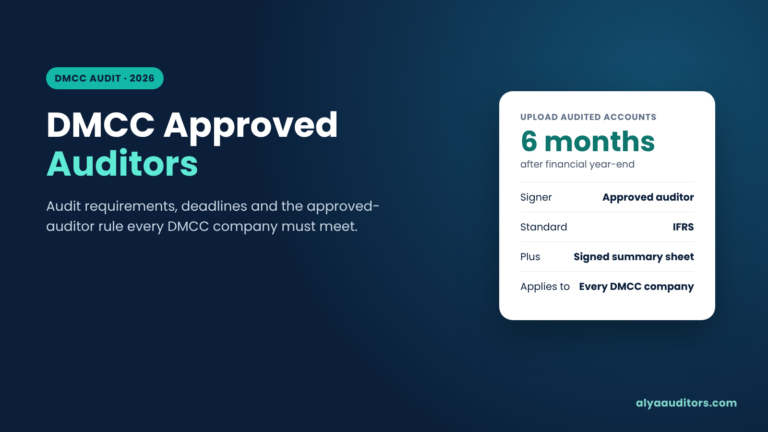 Audit & Assurance Services DMCC Approved Auditors: 2026 Audit Requirements Guide
October 12, 2026
Audit & Assurance Services DMCC Approved Auditors: 2026 Audit Requirements Guide
October 12, 2026
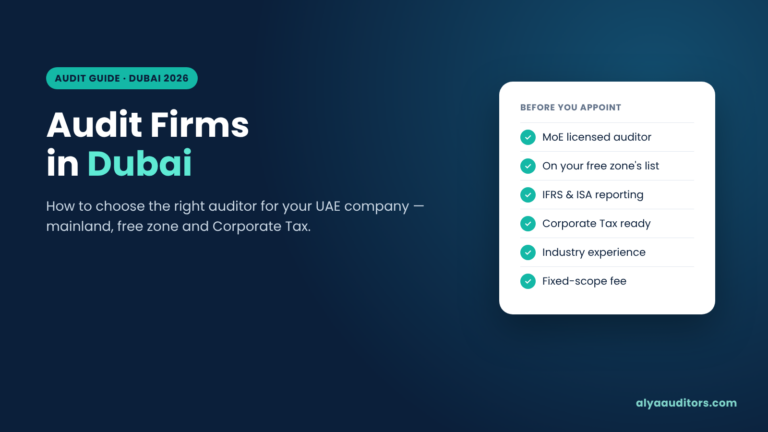 Audit & Assurance Services Audit Firms in Dubai: How to Choose the Right Auditor
October 9, 2026
Audit & Assurance Services Audit Firms in Dubai: How to Choose the Right Auditor
October 9, 2026
 Audit & Assurance Services Corporate Tax Registration UAE: Who Needs to Register and What Happens If You Delay?
October 5, 2026
Audit & Assurance Services Corporate Tax Registration UAE: Who Needs to Register and What Happens If You Delay?
October 5, 2026
Ready to Start?
Talk to a UAE compliance expert
Book a free, no-obligation consultation with ALYA Nexus Auditing.
Book Free Consultation ↗