
UAE E-Invoicing, ready before your go-live date
We connect your ERP or accounting software to the UAE PEPPOL network, turn every invoice into PINT-AE XML and report it to the FTA. Businesses with AED 50M+ revenue go live on 1 January 2027; everyone else follows by 1 July 2027.
 4.9 rating
- B2B & B2G invoices
- Keeps your current ERP
AED 50M+ businesses
UAE e-invoicing deadlines for 2026 and 2027
Your dates depend on your annual revenue. Large businesses go first; everyone else follows six months later.
- Today
- Jul 2026Pilot startsSelected B2B and B2G taxpayers test the system.started
- 30 Oct 2026ASP deadline, AED 50M+Large businesses had to appoint an ASP.passed
- 1 Jan 2027Go-live, AED 50M+E-invoicing becomes mandatory for large businesses.in 57 days
- 31 Mar 2027ASP deadline, all othersEvery other business must appoint an ASP.in 146 days
- 1 Jul 2027Go-live, all othersBusinesses under AED 50M go live.in 238 days
- 1 Oct 2027Government entitiesFederal and local government go live.in 330 days
Source: UAE Ministry of Finance · Ministerial Decisions 243 & 244 of 2025 (as amended) · Cabinet Decision No. 106 of 2025
Which deadline applies to you?
The ASP deadline has passed. If you have not appointed one yet, do it now: penalties start from go-live.
Most projects take 4 to 8 weeks. Starting early leaves time to clean master data and test with your customers.
Government entities receive B2G invoices from suppliers sooner, so receiving should be ready before your own go-live.
In a VAT tax group? Invoices between members of the same group are out of scope until 31 December 2028 (Ministerial Decision No. 197 of 2026). Invoices to outside customers still count.
A PDF by email will no longer count as the invoice
For B2B and B2G sales, the legal invoice becomes a structured data file. People still see a readable invoice; the systems exchange XML.
PDF or paper invoice
- Sent by email, keyed in by hand by your customer
- Typos in TRNs, amounts and VAT go unnoticed
- The FTA sees the data only when you file your return
Structured e-invoice
- PINT-AE XML sent over PEPPOL, straight into the buyer's system
- Checked against the schema before it leaves, so errors are caught early
- Tax data reported to the FTA as invoices are exchanged
Penalties under Cabinet Decision No. 106 of 2025
Fines apply from your go-live date. B2C invoices are outside the mandate for now.
Appoint your ASP nowThe PEPPOL five-corner model, and where we sit
Every invoice passes through two accredited service providers. As your ASP we are corner 2: we take the invoice from your system, make it compliant and deliver it.
- 1Your businessIssues the invoice in your ERP
- 2Alya’s ASPConverts, validates and sends
- 3Buyer's ASPReceives it over PEPPOL
- 4Your customerGets data, not a PDF
- 5FTAReceives the tax data
Four steps from assessment to go-live
Most businesses are live within 4 to 8 weeks, depending on their systems and invoice volumes.
- 1
Readiness check
We map your invoice types, customers, ERP output and data gaps (TRNs, item codes, tax categories) and give you a go-live plan.
- 2
Connect
We link your ERP or accounting system to our platform by API, then test in a sandbox with real invoice samples.
- 3
Go live
Invoices are converted to PINT-AE, validated, sent over PEPPOL and reported to the FTA automatically.
- 4
Stay compliant
We monitor every transmission, alert you to rejected invoices and keep an audit trail ready for the FTA.
Keep your ERP. We plug into it.
We connect to SAP, Oracle Financials, Microsoft Dynamics 365, Zoho Books, QuickBooks, Xero and custom systems. Here is what each team gets.
- REST API connection to your ERP or accounting system
- No system replacement: your current stack stays
- Sandbox testing before go-live
- Encrypted transmission and ISO 27001-grade data handling
- Invoices generated in PINT-AE automatically
- Fewer disputes: buyers receive clean, validated data
- Full audit trail of every invoice sent and received
- Clear per-invoice pricing, quoted up front
- VAT fields checked on every invoice before it is sent
- FTA reporting through the PEPPOL network
- Alerts for rejected or failed invoices
- Advice from our tax team on FTA queries and audits
What e-invoicing does for your business
Errors caught before the invoice leaves
Every invoice is validated against the PINT-AE rules, so mistakes are fixed at source instead of turning into disputes or VAT adjustments.
Faster processing
No printing, scanning or re-keying: invoices move system to system.
Clear visibility
See what was sent, received and reported in near real time.
Secure exchange
Invoices travel over an encrypted, accredited network.
Less paper, lower cost
Cut printing, postage and storage across your supply chain.
PINT-AE and PEPPOL, explained simply
For your IT and finance teams: what the standard requires and what we handle for you.
01What is PINT-AE?
PINT-AE is the UAE version of the PEPPOL International Invoice. It builds on PEPPOL BIS Billing 3.0 and adds UAE fields for VAT and Corporate Tax. Every B2B and B2G e-invoice on the UAE network must follow this XML schema, written in UBL 2.1 syntax.
02What goes into a compliant invoice?
A unique invoice number, supplier and buyer details (TRN, legal name, address), line items, VAT at 5% or 0%, tax totals, payment terms and a digital signature that proves the document has not been changed. Because it is data rather than a PDF, the buyer and the FTA can validate and process it automatically.
03What exactly does an ASP do?
An Accredited Service Provider converts your system output to PINT-AE, validates it, sends it over PEPPOL to your customer's ASP, reports the tax data to the FTA and keeps a tamper-proof log. You must appoint one by your deadline: AED 50M+ businesses by 30 October 2026, all others by 31 March 2027.
04How does the ERP connection work?
Our platform connects by REST API. It takes invoice data from your system, checks it against the schema, applies the UAE tax rules, signs it and passes it to the PEPPOL access point, all in seconds. Nothing needs to be replaced.
05Which transactions are in scope?
B2B and B2G invoices. B2C invoices are excluded for now. If you sell to both businesses and consumers, your system needs to tell the two apart so only B2B and B2G invoices go through PEPPOL.
- 1Invoice number and dateA unique number and the issue date, so the invoice can never be sent twice.
- 2Seller details and TRNYour legal name, address and VAT Tax Registration Number.
- 3Buyer details and TRNYour customer's legal name, address and TRN. A missing or wrong buyer TRN is a common reason for rejection.
- 4Line items and VAT categoryWhat was supplied, quantity, price and the VAT treatment of each line: 5%, 0% or exempt.
- 5VAT and totals in AEDThe VAT amount and the total payable, shown in AED even if you invoice in another currency.
- 6Digital signatureA signature that proves the invoice was not changed after it was issued.
View this invoice as XML (simplified)
<Invoice xmlns="urn:oasis:names:specification:ubl:schema:xsd:Invoice-2">
  <cbc:CustomizationID>urn:peppol:pint:billing-1@ae-1</cbc:CustomizationID>
  <cbc:ID>INV-2027-0142</cbc:ID>                 <!-- 1 -->
  <cbc:IssueDate>2027-01-04</cbc:IssueDate>
  <cbc:DocumentCurrencyCode>AED</cbc:DocumentCurrencyCode>
  <cac:AccountingSupplierParty>                       <!-- 2 -->
    <cbc:RegistrationName>Seller Trading LLC</cbc:RegistrationName>
    <cbc:CompanyID>100000000000003</cbc:CompanyID>
  </cac:AccountingSupplierParty>
  <cac:AccountingCustomerParty>                       <!-- 3 -->
    <cbc:RegistrationName>Buyer Industries LLC</cbc:RegistrationName>
    <cbc:CompanyID>100000000000005</cbc:CompanyID>
  </cac:AccountingCustomerParty>
  <cac:TaxTotal>                                      <!-- 5 -->
    <cbc:TaxAmount currencyID="AED">2500.00</cbc:TaxAmount>
    <cac:TaxSubtotal>
      <cbc:TaxableAmount currencyID="AED">50000.00</cbc:TaxableAmount>
      <cbc:Percent>5</cbc:Percent>
    </cac:TaxSubtotal>
  </cac:TaxTotal>
  <cac:LegalMonetaryTotal>
    <cbc:PayableAmount currencyID="AED">52500.00</cbc:PayableAmount>
  </cac:LegalMonetaryTotal>
  <cac:InvoiceLine><!-- 4: one per line item --></cac:InvoiceLine>
</Invoice>
Read more about UAE e-invoicing
Plain-English guides from our tax team on deadlines, penalties, the 2026 changes and choosing a provider.
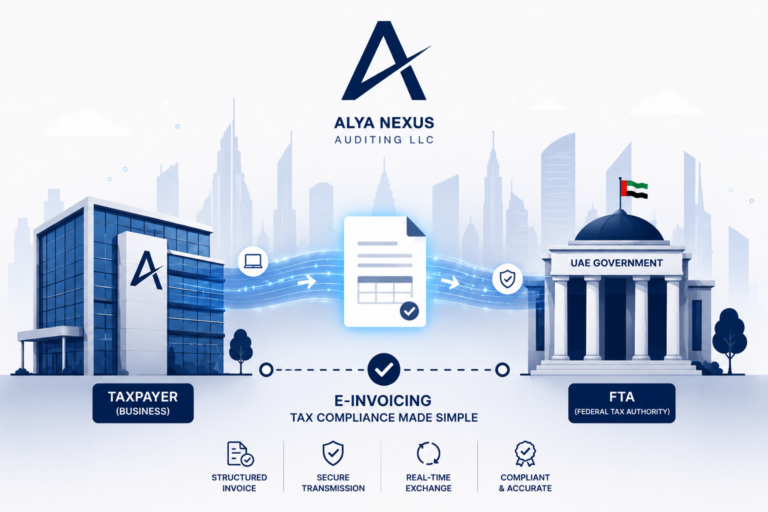 GuideHow to Choose an E-Invoicing Service Provider (ASP) in the UAE: 2027 ChecklistA 10-point checklist for comparing ASPs, the questions to ask in a demo and the red flags to avoid.Read the guide GuideUAE E-Invoicing 2027: The Complete Business Readiness GuideThe 2027 timeline, who is in scope, how the five-corner model works and what PINT-AE invoices must contain.Read the guide
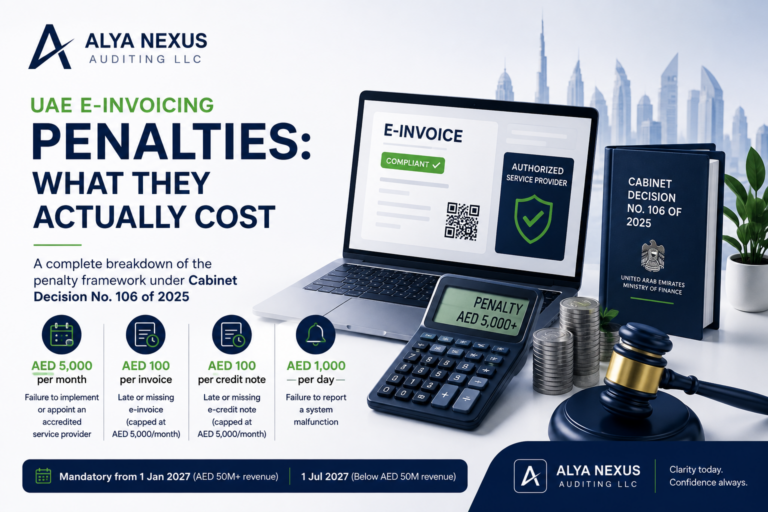 GuideUAE E-Invoicing Penalties: What They Actually CostWhat Cabinet Decision No. 106 of 2025 really costs: monthly fines, per-invoice fines and the caps.Read the guide
 GuideUAE E-Invoicing Amendments 2026: Decision 197 ExplainedThe 2026 changes: the tax group break until 2028, the end of the UAE storage rule and what has not changed.Read the guide
 GuideUAE E-Invoicing 2027 :Everything Your Business Must KnowWho must comply, the key deadlines, a step-by-step compliance checklist and how to budget for it.Read the guide
 GuideE-Invoicing in the UAE: The Complete Guide for CompaniesThe basics: what e-invoicing is, the UAE rules behind it and the benefits for your business.Read the guide
Frequently asked questions about UAE e-invoicing
Can't find your answer? Talk to our team.
Does the UAE e-invoicing mandate apply to my business?
Yes, if you issue B2B or B2G invoices; B2C invoices are excluded for now. Businesses with AED 50M+ annual revenue had to appoint an ASP by 30 October 2026 and go live on 1 January 2027. All other businesses must appoint an ASP by 31 March 2027 and go live by 1 July 2027. Government entities go live by 1 October 2027.
What is the PEPPOL framework?
PEPPOL is an international network and set of standards for exchanging business documents securely. The UAE uses its five-corner model: supplier, supplier's ASP, buyer's ASP, buyer, and the FTA.
Do I need to replace my existing accounting or ERP system?
No. We connect to SAP, Oracle, Microsoft Dynamics 365, Zoho Books, QuickBooks, Xero and custom systems, and convert your invoices to the required XML format.
What is an Accredited Service Provider (ASP)?
An ASP is a provider authorised by the FTA to send and receive e-invoices for you. Alya acts as your ASP and handles the technical and compliance side.
How long does implementation take?
Most businesses are live within 4 to 8 weeks, depending on their systems and invoice volumes. We recommend starting at least 3 months before your deadline.
What happens if we miss the compliance deadline?
Under Cabinet Decision No. 106 of 2025, the fine is AED 5,000 a month for not appointing an ASP or not going live on time, plus AED 100 per e-invoice not issued or sent correctly, capped at AED 5,000 a month. If your AED 50M+ business has no ASP yet, appoint one now.
Are invoices between companies in the same tax group included?
Not at first. Under Ministerial Decision No. 197 of 2026, transactions between members of the same VAT tax group are excluded from 1 January 2027 to 31 December 2028. Invoices to customers outside the group are in scope, and you must still appoint an ASP and go live on time.
Does our e-invoice data have to be stored in the UAE?
No longer. Since 1 October 2026, Ministerial Decision No. 197 of 2026 removed the UAE storage rule. You must still keep e-invoices for the Tax Procedures Law retention period and produce them to the FTA on request.
Get compliant before your deadline, not after it
Tell us about your systems and invoice volumes. We will show you the platform, confirm your dates and give you a fixed plan to go live.
- Free readiness assessment, no obligation
- Set-up, testing and go-live handled for you
- Connects to your current ERP or accounting system
- FTA-authorised Accredited Service Provider
- Ongoing monitoring and tax support
Request received
Our team will be in touch within 24 hours to book your call.