
DMCC Approved Auditors: 2026 Audit Requirements Guide
 October 12, 2026
9 min read
October 12, 2026
9 min read
Every DMCC company must file audited financial statements every year — and DMCC will only accept them if they are signed by an auditor on its Approved Auditors List.
That second condition catches more businesses than the deadline itself. A perfectly good audit by a firm that isn’t DMCC-approved can be rejected, leaving the company to start again, delay its licence renewal and risk sanctions.
The rules were also updated recently. DMCC issued new Approved Auditor Rules (version 3.0) in June 2025 and updated its submission guidelines in April 2025. On top of that, many DMCC companies now need audited statements for Corporate Tax as well.
This guide explains who must file, what a DMCC approved auditor is, the deadline, what the report must contain, how the DMCC audit links to Corporate Tax, and the step-by-step process.
Which DMCC companies must submit audited accounts?
According to DMCC’s submission guidelines, every DMCC member company must upload audited financial statements each year, including subsidiaries and branch companies.
In practice, that covers:
- DMCC Free Zone Companies (DMCC FZCOs), whether owned by individuals or corporate shareholders
- Branches of UAE or foreign companies registered in DMCC
- Companies with low or no activity — the obligation follows the licence, not the revenue
- Newly incorporated companies, once their first financial year ends
There is no turnover threshold. A DMCC company that traded very little, or not at all, still needs audited accounts if its licence was active during the year.
The one auditor exemption: branches in a group audit
The requirement to use a DMCC approved auditor does not apply to a branch company that is covered by its parent’s group audit. A branch that is audited on a standalone basis must still use an approved auditor.
What is a DMCC approved auditor?
A DMCC approved auditor is an audit firm that DMCC Authority has registered and placed on its Approved Auditors List (AAL). Under the Approved Auditor Rules (version 3.0, June 2025):
- The firm must be a UAE commercial entity with a valid trade licence for auditing.
- The audit partner who signs the report must hold a Ministry of Economy certificate and be legally authorised to report on company accounts.
- Approval lasts 12 months. Firms must renew at least 20 business days before expiry, so an auditor’s approval can lapse.
- DMCC can suspend, reject or remove an auditor from the list at its discretion. A suspended firm cannot take new DMCC engagements.
DMCC’s rules place a clear duty on the company too: you must check the Approved Auditors List both when you engage the auditor and again at renewal. DMCC may reject financial statements signed by a non-approved auditor and can sanction the company, not just the auditor.
How to verify your auditor
- Check the firm’s name on the current DMCC Approved Auditors List.
- Confirm the signing audit partner and their Ministry of Economy registration.
- Ask when the firm’s DMCC approval next renews, especially if your audit will be signed close to that date.
- Keep a record of the check with your audit file.
DMCC audit deadline
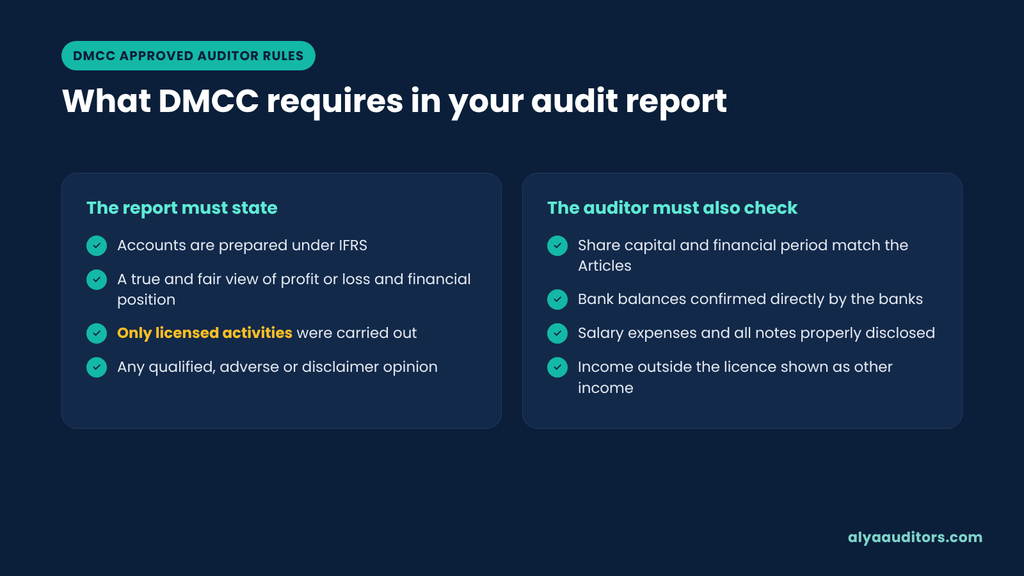
DMCC’s submission guidelines require companies to upload their audited financial statements within six months after the end of each financial year.
| Financial year-end | DMCC submission deadline |
|---|---|
| 31 December 2025 | 30 June 2026 |
| 31 March 2026 | 30 September 2026 |
| 30 June 2026 | 31 December 2026 |
| 31 December 2026 | 30 June 2027 |
You may see other figures online, including 90 days. Always follow the deadline shown in your DMCC Member Portal and the current DMCC guidelines, since DMCC can update them or announce extensions.
What you submit
Two documents are uploaded through the DMCC Member Portal, under Compliance Services:
- The full audited financial statements
- The Audited Financial Statements Summary Sheet — a DMCC template that the auditor completes, prints on its letterhead, signs and stamps
The portal reads the summary sheet using OCR and auto-fills the key figures. You must check those figures, correct any errors and enter the approved auditor’s name before submitting. DMCC can ask for additional documents at any time.
What DMCC requires in the auditor’s report
DMCC’s Approved Auditor Rules go further than a standard audit opinion. The auditor’s report must state:
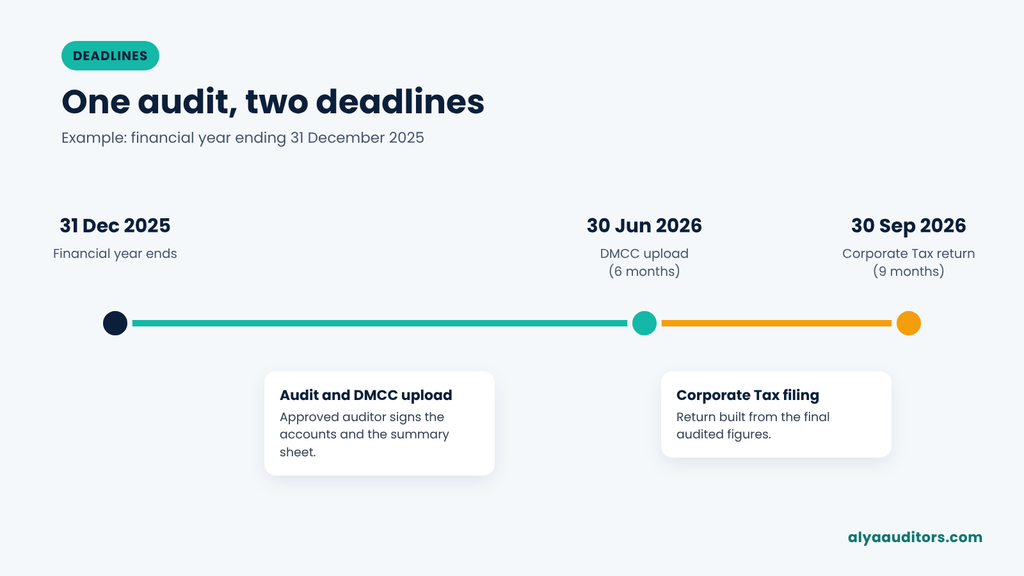
- Whether the annual accounts are properly prepared under IFRS
- Whether they give a true and fair view of the profit or loss for the year and the financial position at year-end
- Whether the company has only carried out activities permitted by its DMCC licence
- Any qualified, adverse or disclaimer opinion, where applicable
- Any other matter DMCC requires
Before signing, the auditor must also be satisfied that:
- Share capital and the financial period match the company’s Articles of Association
- Bank balances are confirmed directly by the banks, and any bank account not disclosed is highlighted
- Salary expenses and all notes are properly disclosed
- Income from activities outside the licence is disclosed separately as other income
Why the licence-activity check matters
This is specific to DMCC and often overlooked. If your company has been earning income from activities not listed on its licence, your auditor must report it. That can trigger questions from DMCC and, for Corporate Tax, can affect whether income counts as qualifying income for the 0% free zone rate. It is far better to fix licence activities before year-end than to have them flagged in the audit report.
DMCC audit and Corporate Tax
For many DMCC companies, one audit now has to satisfy two authorities: DMCC and the Federal Tax Authority (FTA).
Qualifying Free Zone Persons must have audited financial statements. If your DMCC company wants the 0% Corporate Tax rate on qualifying income, Ministerial Decision No. 84 of 2025 requires audited financial statements, regardless of revenue. Without them, QFZP status — and the 0% rate — can be lost.
The Corporate Tax return is due nine months after year-end. The DMCC upload is due at six months. Plan to finish the audit by the DMCC deadline, which also leaves time to prepare the tax return from the final audited figures.
The audit should be tax-aware. For QFZPs, the audit and the tax return need to support:
- A clear split of qualifying and non-qualifying income
- Related-party transactions at arm’s length, with proper disclosures
- Adequate substance in DMCC — staff, premises and decision-making
- The de minimis test for non-qualifying revenue
An auditor who understands these rules can flag problems while there is still time to fix them, rather than after the return is filed.
| Year-end 31 Dec 2025 | Deadline |
|---|---|
| DMCC audited accounts upload | 30 June 2026 |
| Corporate Tax return and payment | 30 September 2026 |
What happens if your DMCC audit is late or non-compliant?
Missing the deadline, or filing a report DMCC won’t accept, can lead to:
- Rejected submissions — DMCC may reject financial statements signed by an auditor who is not on the Approved Auditors List
- Sanctions on the company — DMCC’s rules allow it to sanction the member company, not only the auditor
- Licence renewal delays — an outstanding audit can hold up your annual renewal
- Knock-on effects on visas and banking — a blocked renewal can stop visa processing and raise questions from your bank
- Corporate Tax exposure — a QFZP without audited statements risks losing the 0% rate, and a late tax return attracts FTA penalties
DMCC sets its own fines, which can change, so check the current fee schedule in your Member Portal. The simplest protection is to appoint an approved auditor early and start fieldwork soon after year-end.
The DMCC audit process, step by step
- Close your books for the financial year and reconcile every bank account.
- Appoint a DMCC approved auditor and confirm the firm is on the current Approved Auditors List.
- Share your documents (see the list below) through a secure portal.
- Fieldwork — the auditor tests balances, sends bank confirmations, checks share capital against your Articles and reviews licence activities.
- Draft financial statements are shared for your review and management representations.
- Final report — the auditor issues the signed audited financial statements and completes, signs and stamps the DMCC Summary Sheet.
- Upload to the DMCC Member Portal under Compliance Services, check the OCR figures and submit.
- Use the audited figures for your Corporate Tax return, due nine months after year-end.
Documents to prepare
- DMCC licence, Memorandum and Articles of Association, and share certificates
- Trial balance and general ledger
- Bank statements for all accounts and authorisation for bank confirmations
- Sales and purchase invoices and key contracts
- Fixed asset register
- Payroll records and visa/employee list
- Related-party agreements and balances
- Prior-year audited financial statements
- VAT returns and Corporate Tax registration details
Common DMCC audit mistakes
- Using an auditor who isn’t on the DMCC list — or whose approval has lapsed.
- Assuming a dormant company doesn’t need an audit.
- Leaving it until month five. Bank confirmations alone can take weeks.
- Not checking the OCR-extracted figures on the portal before submitting.
- Earning income outside licensed activities without amending the licence.
- Treating the DMCC audit and Corporate Tax as separate jobs, then finding the audit doesn’t support the QFZP position.
How Alya Auditors helps DMCC companies
Alya Auditors works with DMCC companies to get the annual audit done correctly, on time and in a way that supports their Corporate Tax position:
- DMCC audits under IFRS and ISA, including the licence-activity, bank confirmation and share capital checks DMCC requires
- DMCC Summary Sheet preparation and support with the Member Portal upload
- Corporate Tax-ready audited statements for Qualifying Free Zone Persons, with qualifying income and related-party analysis
- A fixed timeline planned back from your DMCC and Corporate Tax deadlines
Learn more about our DMCC Approved Auditors service, or read our wider guide to choosing an audit firm in Dubai.
Is your DMCC audit due? Speak with an approved auditor. Share your year-end and company details, and we’ll confirm your deadlines and send a fixed-scope proposal.
Frequently asked questions
Do all DMCC companies need an audit?
Yes. DMCC requires every member company, including subsidiaries and branches, to upload audited financial statements each year, regardless of revenue or activity level.
What is the DMCC audit deadline?
DMCC’s guidelines require audited financial statements to be uploaded within six months of the financial year-end — for example, by 30 June 2026 for a 31 December 2025 year-end. Check your Member Portal for any extensions.
Can any UAE auditor audit a DMCC company?
No. The auditor must be on DMCC’s Approved Auditors List, and the signing partner must hold a Ministry of Economy certificate. DMCC may reject statements signed by a non-approved auditor.
Do DMCC branches need an approved auditor?
A branch covered by its parent company’s group audit is exempt from the approved-auditor requirement. A branch audited on a standalone basis must use a DMCC approved auditor.
What is the DMCC Audited Financial Statements Summary Sheet?
It is a DMCC template summarising key figures from your audited accounts. Your auditor completes it, prints it on its letterhead, signs and stamps it, and you upload it with the full financial statements.
Does a DMCC company need audited accounts for Corporate Tax?
If it claims Qualifying Free Zone Person status and the 0% rate, yes — audited financial statements are mandatory under Ministerial Decision No. 84 of 2025. They are also required if revenue exceeds AED 50 million.
Does a dormant DMCC company need an audit?
Yes. The obligation is linked to the active licence, not to trading activity.
This article is general guidance based on DMCC and UAE publications as of October 2026 and is not professional advice. DMCC rules and deadlines can change; check the DMCC Member Portal for your company’s current requirements.

Keep reading
 Audit & Assurance Services Audit Firms in Dubai: How to Choose the Right Auditor
October 9, 2026
Audit & Assurance Services Audit Firms in Dubai: How to Choose the Right Auditor
October 9, 2026
 Audit & Assurance Services Corporate Tax Registration UAE: Who Needs to Register and What Happens If You Delay?
October 5, 2026
Audit & Assurance Services Corporate Tax Registration UAE: Who Needs to Register and What Happens If You Delay?
October 5, 2026
 Audit & Assurance Services Free Zone Companies: Your September 30 Deadline Applies Too, Even at 0% Tax
September 17, 2026
Audit & Assurance Services Free Zone Companies: Your September 30 Deadline Applies Too, Even at 0% Tax
September 17, 2026
Ready to Start?
Talk to a UAE compliance expert
Book a free, no-obligation consultation with ALYA Nexus Auditing.
Book Free Consultation ↗