
Audit Firms in Dubai: How to Choose the Right Auditor
 October 9, 2026
11 min read
October 9, 2026
11 min read
Choosing an auditor in Dubai used to be a once-a-year formality for licence renewal. Since Corporate Tax arrived, it has become a decision that affects your tax position, your free zone status and how banks and investors see your business.
There are hundreds of audit firms in Dubai, and on the surface they look alike. They all promise IFRS-compliant reports, fast turnaround and competitive fees. The real differences show up later: when a free zone rejects a report because the auditor isn’t on its approved list, when audited statements aren’t ready for the Corporate Tax deadline, or when an auditor who doesn’t understand your industry misses something the FTA will not.
This guide explains the types of audit UAE companies need, who must be audited, what “approved auditor” really means, what your audit report should contain, and a practical checklist for choosing the right audit firm in Dubai.
Types of audit in the UAE
Not every audit serves the same purpose. Before comparing firms, be clear which of these you actually need.
| Audit type | What it is | Who usually needs it |
|---|---|---|
| Statutory audit | The annual audit required by law or by your licensing authority. The auditor gives an independent opinion on whether your financial statements are fairly presented under IFRS. | Mainland LLCs, branches, joint stock companies and most free zone companies |
| External audit | Any audit by an independent firm outside your company. A statutory audit is one type; others include audits requested by banks, investors or parent companies. | Businesses raising finance, applying for tenders or reporting to a group |
| Internal audit | A review of your internal controls, processes and risks, reporting to management or the board rather than to outside parties. It can be in-house or outsourced. | Growing SMEs, family businesses, regulated entities and companies with cash-heavy operations |
| Free zone audit | A statutory audit performed to your free zone’s specific rules, usually by an auditor on that zone’s approved list. | Companies in DMCC, JAFZA, DAFZA, IFZA, Dubai South and most other zones |
| Corporate Tax audit | Audited financial statements prepared to support your Corporate Tax return. | Qualifying Free Zone Persons, tax groups and businesses with revenue above AED 50 million |
| Special-purpose audits | Agreed-upon procedures, liquidation audits, due diligence and fraud investigations. | Companies closing down, being acquired or responding to a specific issue |
Many businesses need more than one. A free zone company claiming the 0% Qualifying Free Zone Person rate, for example, needs an audit that satisfies both its free zone and the Corporate Tax rules.
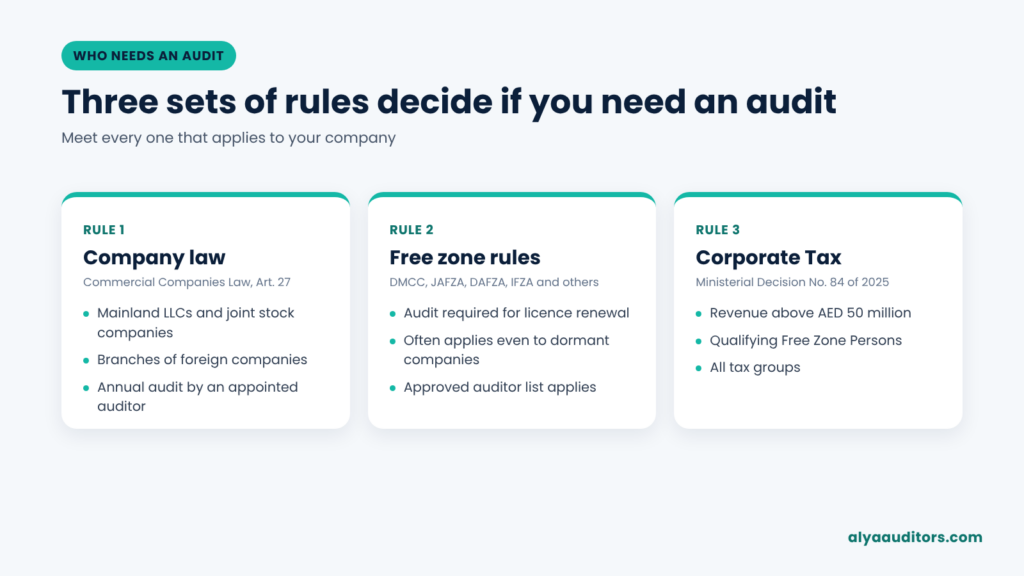
Who needs an audit in Dubai?
Three sets of rules decide whether your company must be audited. You need to satisfy every one that applies to you.
1. Company law (mainland)
Under Article 27 of the Commercial Companies Law (Federal Decree-Law No. 32 of 2021), a company must appoint one or more auditors to audit its accounts every year. This covers mainland LLCs, joint stock companies and branches of foreign companies. Financial statements are normally presented to shareholders within four months of the financial year-end.
2. Free zone regulations
Most Dubai free zones, including DMCC, JAFZA, DAFZA and Dubai South, make an audited report a condition of licence renewal — often regardless of revenue, and even for dormant or newly incorporated companies. Submission deadlines vary by zone and are commonly around 90 days to six months after year-end. Missing them can block licence renewal and visa processing.
3. Corporate Tax
Under Ministerial Decision No. 84 of 2025, which applies to financial years starting on or after 1 January 2025, audited financial statements are required for:
- Businesses with revenue above AED 50 million in the tax period
- Qualifying Free Zone Persons claiming the 0% rate, regardless of revenue
- All tax groups, which must prepare audited special-purpose financial statements
The audited statements must be ready in time for the Corporate Tax return, which is due nine months after your tax period ends — even if your free zone allows longer.
Who may not need a statutory audit?
Some smaller mainland businesses, such as certain sole establishments and civil companies, may not face a legal audit requirement. Businesses using Small Business Relief also do not need audited statements for Corporate Tax purposes. But banks, landlords, tender authorities and future buyers often ask for audited accounts anyway, so check before you decide to skip one.
What “approved auditor” really means
An audit report is only useful if the authority receiving it accepts the auditor who signed it. In Dubai, that involves two layers of approval.
Ministry of Economy licence. Under Federal Decree-Law No. 41 of 2023, which regulates the accounting and auditing profession, auditors and audit firms practising in the UAE must be licensed by the Ministry of Economy. Unlicensed practice can lead to heavy fines and suspension.
Free zone approved lists. Most free zones keep their own list of approved auditors. A report signed by a firm that is not on your zone’s list can be rejected at licence renewal, however good the audit itself was. DMCC, JAFZA, DAFZA and IFZA all apply some version of this rule.
How to check an audit firm
- Ask for the firm’s Ministry of Economy licence details and the name of the signing partner.
- Confirm the firm is on your free zone’s current approved-auditor list — lists change, so check at the time of appointment.
- If you are in a regulated sector, confirm any extra approvals your regulator requires.
For DMCC companies specifically, see our guide to DMCC approved auditors.
What your audit report should contain
UAE companies generally prepare financial statements under International Financial Reporting Standards (IFRS), or IFRS for SMEs where permitted. Audits are carried out under International Standards on Auditing (ISA). A complete audit pack normally includes:
- Independent auditor’s report, with the auditor’s opinion
- Statement of financial position (balance sheet)
- Statement of profit or loss and other comprehensive income
- Statement of changes in equity
- Statement of cash flows
- Notes to the financial statements, including accounting policies and related-party disclosures
- Directors’ or managers’ report, where required
The four audit opinions
| Opinion | What it means |
|---|---|
| Unqualified (clean) | The financial statements give a true and fair view. This is what banks, free zones and the FTA expect to see. |
| Qualified | Fair overall, except for a specific issue — for example, inventory the auditor could not verify. |
| Adverse | The financial statements are materially misstated. |
| Disclaimer | The auditor could not obtain enough evidence to form an opinion, usually because records were missing. |
A qualified opinion or disclaimer can delay licence renewal, raise questions from your bank and attract FTA attention. Most are avoidable with clean bookkeeping and an auditor who flags issues early, not at the end.
How to choose the right audit firm in Dubai
Use these eight questions to compare firms. A good firm will answer every one clearly before you sign.
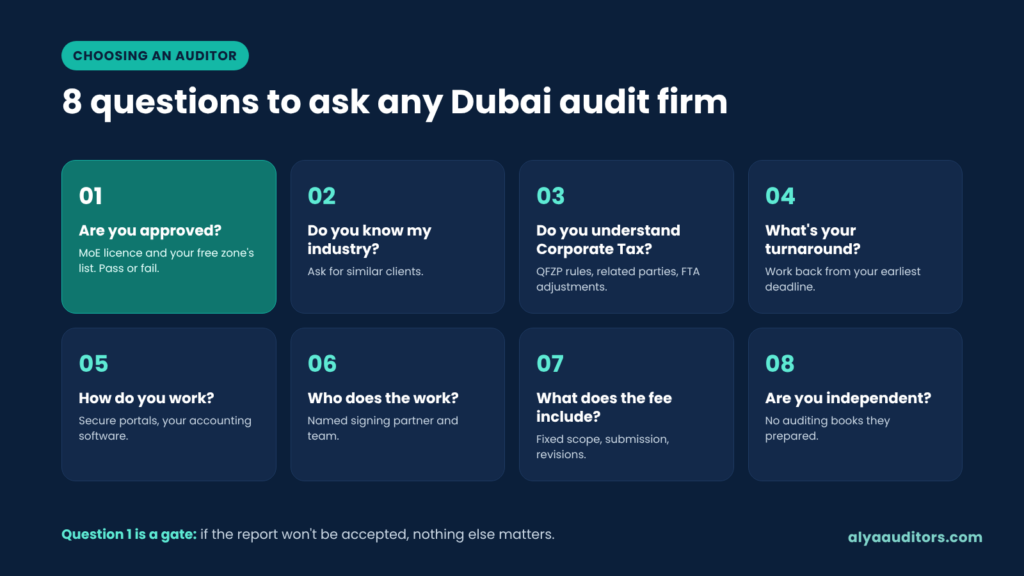
1. Are you approved where I need you to be? Confirm the Ministry of Economy licence and your free zone’s approved list. This is a pass/fail test — nothing else matters if the report will be rejected.
2. Do you know my industry? An auditor who already audits restaurants understands delivery-platform commissions and cash controls. One who audits real estate understands off-plan revenue and escrow. Industry knowledge means better questions, fewer surprises and a faster audit. Ask for examples of similar clients.
3. Do you understand Corporate Tax? Your audited statements are now the starting point for your tax return. Your auditor should understand Qualifying Free Zone Person conditions, related-party disclosures and the adjustments the FTA will look for.
4. What is your realistic turnaround time? Ask how long fieldwork and reporting take once you hand over complete records, and how they handle peak season. Work backwards from your earliest deadline — free zone or Corporate Tax.
5. How do you work technically? Cloud-based document sharing, secure portals and familiarity with your accounting software (Zoho Books, QuickBooks, Xero, Tally, Odoo) cut weeks off an audit.
6. Who will actually do the work? Find out who signs the report, who leads fieldwork and how often you can speak to the partner.
7. What exactly does the fee include? Get a fixed-scope quote. Check whether it covers the free zone submission, a management letter, revisions and follow-up queries. A low fee with extra charges for each of these is not cheaper.
8. Are you independent? An auditor cannot audit work it has prepared. If the same firm keeps your books, ask how it separates the two teams, or use different firms.
Quick comparison checklist
- ✅ Ministry of Economy licence confirmed
- ✅ On my free zone’s approved auditor list
- ✅ Experience with my industry
- ✅ Understands Corporate Tax and QFZP rules
- ✅ Turnaround meets my earliest deadline
- ✅ Works with my accounting software
- ✅ Named partner and team
- ✅ Fixed-scope fee in writing
- ✅ No independence conflict
Documents your auditor will need
Having these ready before fieldwork starts is the single biggest factor in how fast — and how cleanly — your audit finishes.
Company documents
- Trade licence, Memorandum and Articles of Association, and any amendments
- Share certificates and shareholder register
- Board or shareholder resolutions passed during the year
- Prior-year audited financial statements and management letter
Accounting records
- Trial balance and general ledger for the year
- Bank statements for every account, plus year-end bank confirmations
- Sales and purchase invoices, contracts and credit notes
- Fixed asset register with purchase invoices and depreciation schedule
- Inventory count sheets and valuation, if you hold stock
- Debtor and creditor ageing reports
- Loan agreements and related-party balances
Payroll and tax
- Payroll records, WPS files and employee end-of-service calculations
- VAT returns and reconciliations
- Corporate Tax registration details and any relevant elections
If your books are behind, fix that first. Most audit delays in Dubai come from incomplete bookkeeping, not from the auditor.
Red flags when choosing an auditor
- “Audit in 48 hours” with no fieldwork. A real audit involves testing, confirmations and questions. A report produced without them may not survive a free zone or FTA review.
- A price far below the market. It often means minimal work, or a long list of extra charges later.
- No named partner. You should know who is signing your report.
- Vague answers on approvals. If a firm can’t immediately confirm it’s on your free zone’s list, move on.
- No questions about your business. An auditor who doesn’t ask how you make money isn’t assessing risk properly.
How Alya Auditors works
Alya Auditors is an audit and accounting firm serving businesses across Dubai’s mainland and free zones. We focus on audits that do more than satisfy a renewal checklist:
- Statutory and free zone audits under IFRS and ISA, prepared to each zone’s submission requirements
- Corporate Tax-ready audited statements for Qualifying Free Zone Persons, tax groups and businesses above AED 50 million
- Internal audit and controls reviews, including industry-specific work for hospitality, real estate, and trading and e-commerce businesses
- Liquidation and special-purpose audits for companies closing or restructuring
- A clear timeline and fixed-scope fee agreed before work begins
Need an auditor you can rely on? Speak to Alya Auditors. Tell us your company type, free zone and year-end, and we’ll confirm the requirements that apply to you and send a fixed-scope proposal.
Frequently asked questions
Is an audit mandatory for companies in Dubai?
For most companies, yes. Mainland companies must appoint an auditor under the Commercial Companies Law, most free zones require audited accounts for licence renewal, and Corporate Tax rules require audited statements for Qualifying Free Zone Persons, tax groups and businesses with revenue above AED 50 million.
What is the difference between internal and external audit?
An external audit is performed by an independent firm and gives an opinion on your financial statements for outside users such as regulators, banks and shareholders. An internal audit reviews your controls and processes and reports to management.
Can any audit firm audit a free zone company?
No. The firm must be licensed by the Ministry of Economy, and most free zones only accept reports from auditors on their approved list.
Do UAE audits follow IFRS?
Yes. UAE companies generally prepare financial statements under IFRS (or IFRS for SMEs where permitted), and audits follow International Standards on Auditing.
How long does an audit take in Dubai?
For a small or mid-sized company with complete records, an audit typically takes a few weeks from the start of fieldwork. Incomplete bookkeeping is the most common cause of delay.
Does my auditor need to understand Corporate Tax?
It helps significantly. Audited financial statements are the starting point for your Corporate Tax return, and for Qualifying Free Zone Persons and tax groups they are a legal requirement.
Can my accountant also be my auditor?
Not for the same work. An auditor cannot audit financial statements it prepared, so bookkeeping and audit should be handled by separate teams or firms.
This article is general guidance based on UAE laws and regulations as of October 2026 and is not professional advice. Audit requirements vary by free zone and change over time; confirm the rules that apply to your company.

Keep reading
 Audit & Assurance Services Corporate Tax Registration UAE: Who Needs to Register and What Happens If You Delay?
October 5, 2026
Audit & Assurance Services Corporate Tax Registration UAE: Who Needs to Register and What Happens If You Delay?
October 5, 2026
 Audit & Assurance Services Free Zone Companies: Your September 30 Deadline Applies Too, Even at 0% Tax
September 17, 2026
Audit & Assurance Services Free Zone Companies: Your September 30 Deadline Applies Too, Even at 0% Tax
September 17, 2026
 Audit & Assurance Services Reverse Charge VAT UAE: Self-Invoicing Now Removed
September 12, 2026
Audit & Assurance Services Reverse Charge VAT UAE: Self-Invoicing Now Removed
September 12, 2026
Ready to Start?
Talk to a UAE compliance expert
Book a free, no-obligation consultation with ALYA Nexus Auditing.
Book Free Consultation ↗