
UAE E-Invoicing Amendments 2026: Decision 197 Explained
 October 22, 2026
8 min read
UAE eases its e-invoicing rules: what Ministerial Decision No. 197 of 2026 means for your business
The Ministry of Finance has relaxed three parts of the UAE e-invoicing rules, with effect from 1 October 2026. Ministerial Decision No. 197 of 2026, published on 19 October, amends Ministerial Decision No. 243 of 2025, the rulebook that sets out who is in the e-invoicing system and what they must do.
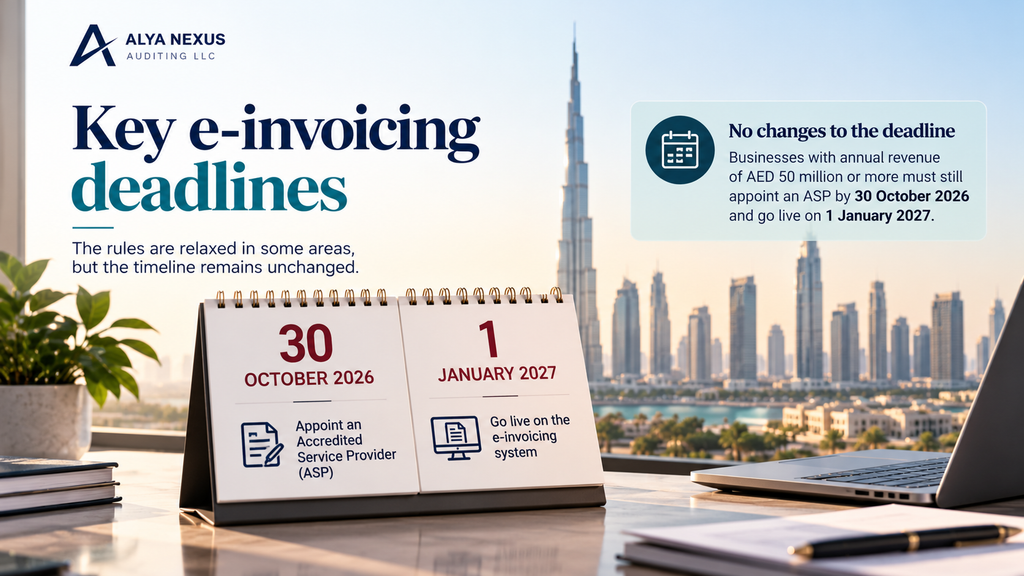
The changes are welcome, but they do not move a single deadline. Businesses with annual revenue of AED 50 million or more still have to appoint an Accredited Service Provider (ASP) by 30 October 2026 and go live on 1 January 2027.
The three changes at a glance

| Area | Before 1 October 2026 | Now | Who benefits most |
| Transactions inside a tax group | In scope from your go-live date | Excluded for 24 months, 1 January 2027 to 31 December 2028 | Groups registered for VAT under one tax group |
| Where e-invoice data is stored (Article 11) | Had to be stored within the UAE | No location rule. Data must be kept for the Tax Procedures Law period and produced to the FTA on request | Businesses on overseas-hosted ERPs, SaaS accounting tools and group shared-service centres |
| System failure (Article 12) | Notify the FTA within two business days of a failure | Article 12 repealed and the definition of “System Failure” deleted | Every business in scope |
1. Tax group transactions get a two-year breather
From 1 January 2027, business transactions between members of the same tax group are treated as excluded transactions for 24 months. In practice, invoices one group company raises to another do not have to run through the e-invoicing system until the end of December 2028.
The Ministry’s stated aim is to give groups more time to adapt. For many groups, intercompany billing is where the ERP work is hardest: several legal entities, sometimes several systems, and charges that are booked by journal rather than by invoice.
What the exclusion does not cover:
- Invoices from a group member to anyone outside the group. These stay in scope from your phase date.
- Your obligation to appoint an ASP and go live on time. A group member that also sells to outside customers still needs a working e-invoicing set-up.
- Your bookkeeping. Intercompany transactions still have to be recorded and supported in the normal way.
One point still needs official clarification: how the system should treat an entity that issues both intra-group and external invoices from the same ERP. Until the FTA publishes guidance, our working assumption is simple. Tag intra-group supplies clearly in the ERP so they can be routed outside the e-invoicing flow, and send everything else through your ASP.
Our advice: use the 24 months to fix intercompany processes, not to park them. The exclusion is temporary, and the clean-up is easier before the system is live than after.
2. Your e-invoice data no longer has to stay in the UAE
This is the change most businesses will feel. The original Article 11 required electronic invoices, electronic credit notes and related data to be stored inside the UAE. Many finance teams were already asking their ERP vendors and ASPs for UAE-hosted archives, and some were budgeting for a second copy of their data held locally.
The amended Article 11 drops the location rule. Businesses in the system must now:
- keep all electronic invoices, electronic credit notes and associated data for the period set by the Tax Procedures Law, and
- make sure those records can be produced to the Federal Tax Authority (FTA) when it asks.
In the Ministry’s own framing, the test has moved from where the data sits to whether it is retained and accessible.
Who gains the most
- Groups running a single global ERP instance hosted in Europe, India or elsewhere.
- Businesses on cloud accounting and logistics platforms whose servers are outside the UAE.
- Companies whose finance function sits in a shared-service centre abroad.
For these businesses, a costly parallel UAE archive is no longer a tax requirement for e-invoices.
What still applies
The change lifts one rule. It does not lift the rest of the framework around your records.
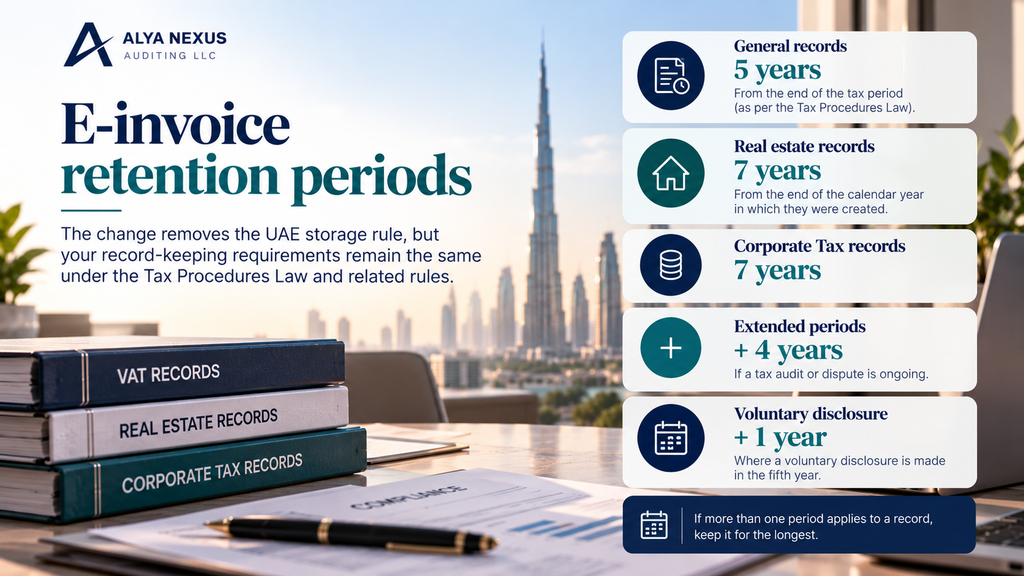
Retention periods are unchanged. Under the Tax Procedures Law and its Executive Regulation (Cabinet Decision No. 74 of 2023), the general rule is five years from the end of the tax period. Real estate records are kept for seven years from the end of the calendar year in which they were created. Corporate Tax records are kept for seven years. The period extends by four years if a tax audit or dispute is ongoing, and by one year where a voluntary disclosure is made in the fifth year. Where more than one period applies to a record, keep it for the longest.
The FTA can still ask for access, quickly. FTA Decision No. 4 of 2026, in force since 30 July 2026, requires accounting records to be complete, identical to the original, legible, and accessible to the FTA on request, including access to the system that holds them. Data held overseas has to be just as easy to produce as data held in Dubai.
Other laws may still restrict cross-border storage. Decision No. 197 removes a tax rule only. Invoices carry customer names, addresses and contact details, so the UAE Personal Data Protection Law (Federal Decree-Law No. 45 of 2021) can still govern transfers abroad. Entities in the DIFC and ADGM have their own data protection regimes. Regulated sectors, such as banking and healthcare, may face separate data residency rules from their regulators. Check these before you move anything.
Your contracts need to keep up. If an ERP vendor or ASP holds your archive abroad, get the hosting region in writing. Make sure the contract gives you export on demand, read access for an auditor, and a full data return if you leave.
Our advice: do not rush to move data offshore simply because you now can. First map where your invoice data actually lives today, then decide on one archive location you control, and test that you can pull a full tax period from it within a day.
3. The two-day system failure notice is gone
Under the original rules, if the e-invoicing system failed (a technical fault, outage or unavailability that stopped invoices going through), the business had to tell the FTA within two business days. Cabinet Decision No. 106 of 2025 backed this with a fine of AED 1,000 per day of delay, for issuers and recipients alike.
Decision No. 197 repeals Article 12 entirely and deletes the definition of “System Failure” from Article 1. With no notification duty left in the Ministerial Decision, the related line in the penalty table no longer has an obligation to attach to. We expect the penalty schedule to be tidied up in due course.
This removes an uncapped daily exposure, which was one of the more anxious points in most readiness plans. It does not remove the duty to issue and transmit e-invoices and credit notes on time, which still carries a fine of AED 100 per document, capped at AED 5,000 a month.
Our advice: keep a simple, dated incident log anyway. Record what failed, when it was fixed, and how the backlog was cleared. If a late invoice is ever questioned, that log is your best evidence.
What has not changed
The phased timeline stands exactly as set by Ministerial Decision No. 244 of 2025, as amended by Ministerial Decision No. 66 of 2026.
| Business | Appoint an ASP by | Go live by |
| Annual revenue of AED 50 million or more | 30 October 2026 | 1 January 2027 |
| Annual revenue below AED 50 million | 31 March 2027 | 1 July 2027 |
| Government entities in scope | 31 March 2027 | 1 October 2027 |
The main penalties under Cabinet Decision No. 106 of 2025 also stand:
| Failure | Fine |
| Not implementing the system, including not appointing an ASP on time | AED 5,000 per month or part of a month |
| Late e-invoice or e-credit note | AED 100 each, capped at AED 5,000 a month |
| Not telling your ASP about changes to your registered data | AED 1,000 per day of delay |
All B2B and B2G transactions remain in scope, apart from the listed exclusions. A PDF is still not an e-invoice: the system runs on structured data exchanged through ASPs, not on documents attached to emails.

Your checklist for the next ten days
If your revenue is AED 50 million or more, the ASP deadline is 30 October. Use the time like this:
- Confirm your ASP appointment. The relaxations do not change the deadline or the AED 5,000 monthly fine.
- Check your tax group status. List every group member and every system that raises intercompany invoices, and flag them for the 24-month exclusion.
- Map your invoice data. Note where e-invoice data, PDFs and attachments sit today: ERP, ASP portal, email, shared drives.
- Get hosting confirmed in writing. Ask your ERP vendor and ASP for the hosting region, retention settings and export options.
- Run a privacy check. If data will be held abroad, confirm the transfer is allowed under the PDPL or your free zone or sector rules.
- Update your incident process. Replace the two-day FTA notice with an internal log and a catch-up plan for late invoices.
- Rewrite your record-keeping policy. Reflect the new Article 11 wording, the retention periods and FTA Decision No. 4 of 2026.
How Alya Auditors can help
Alya Auditors works with UAE businesses on e-invoicing readiness, from scoping and ASP selection to ERP integration and record-keeping reviews. Through AlyaBooks, our e-invoicing product, we connect existing ERP and logistics systems to an FTA-accredited service provider.
If you want a second opinion on your tax group position or where your invoice data should live, talk to our team.
This article is general information based on Ministerial Decision No. 197 of 2026 as reported on 19 October 2026. It is not legal or tax advice for any specific business. Last reviewed: 21 October 2026.
References
- Ministerial Decision No. 243 of 2025 on the Electronic Invoicing System (Ministry of Finance)
- Ministerial Decision No. 66 of 2026 amending Decision No. 244 of 2025 (Ministry of Finance)
- Cabinet Decision No. 106 of 2025 on e-invoicing violations and penalties (Ministry of Finance)
- UAE amends e-invoicing regulations as implementation deadline draws closer (The National, 19 October 2026)
- UAE eases e-invoicing rules (Gulf News, 19 October 2026)
- UAE amends e-invoicing regulations to reduce operational burden (Khaleej Times, 19 October 2026)

Keep reading
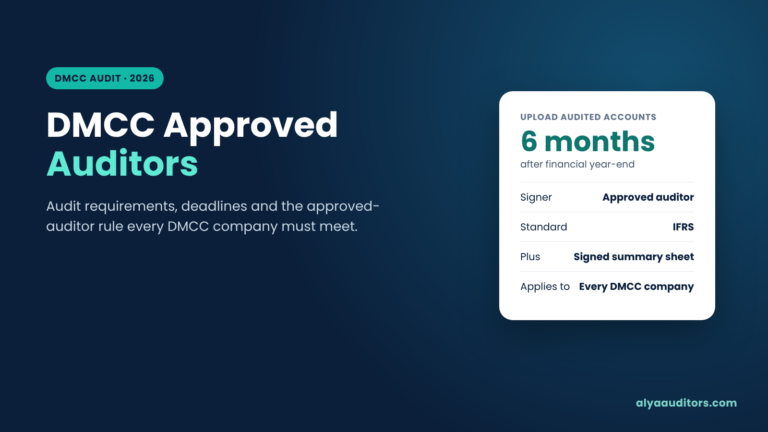 Audit & Assurance Services DMCC Approved Auditors: 2026 Audit Requirements Guide
October 12, 2026
 Audit & Assurance Services Audit Firms in Dubai: How to Choose the Right Auditor
October 9, 2026
 Audit & Assurance Services Corporate Tax Registration UAE: Who Needs to Register and What Happens If You Delay?
October 5, 2026
Ready to Start?
Talk to a UAE compliance expert
Book a free, no-obligation consultation with ALYA Nexus Auditing.
Book Free Consultation ↗