
Corporate Tax Registration UAE: Who Needs to Register and What Happens If You Delay?
 October 5, 2026
10 min read
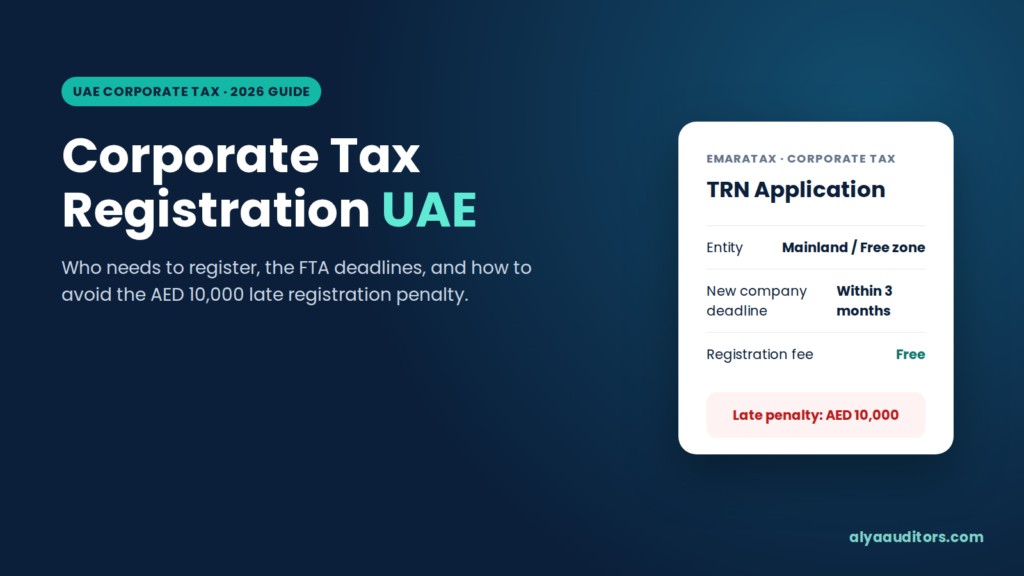
If your business holds a UAE trade licence, it almost certainly needs a Corporate Tax Registration Number (TRN) — even if it will never pay a dirham of tax.
That is the point many business owners miss. Corporate Tax registration is not linked to profit, and it is not optional below the AED 375,000 threshold. It is a separate legal obligation under Article 51 of Federal Decree-Law No. 47 of 2022, with its own deadline and its own penalty.
Miss that deadline and the Federal Tax Authority (FTA) imposes a fixed AED 10,000 administrative penalty. The good news: the FTA’s penalty waiver initiative means many late registrants can still have that penalty cancelled or refunded — but only if they act within a strict window.
This guide explains who needs to register, the deadlines that apply to your business, what happens if you delay, and how to fix a missed registration before it costs you.
Who needs to register for Corporate Tax in the UAE?
Every Taxable Person must register with the FTA and obtain a Corporate Tax TRN. In practice, that covers the following groups.
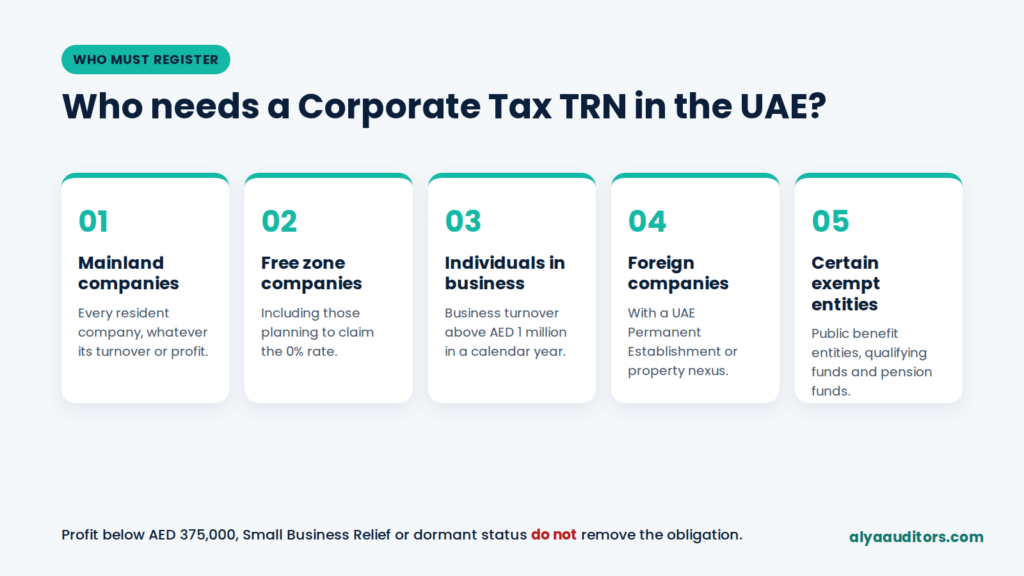
1. UAE mainland companies. Every resident juridical person — LLCs, private and public joint stock companies, branches treated as residents — must register, regardless of turnover or profit.
2. Free zone companies. Free zone entities are Resident Persons under the Corporate Tax Law, so they must register even if they expect to be a Qualifying Free Zone Person taxed at 0%. The 0% rate is something you claim through the system, not a reason to stay outside it.
3. Individuals running a business. A natural person (sole establishment, freelancer, or individual with a licence) must register once their business turnover exceeds AED 1 million in a calendar year. Wages, personal investment income and real estate income held in a personal capacity without a licence are generally excluded.
4. Foreign companies with a UAE connection. A non-resident must register if it has a Permanent Establishment in the UAE or a nexus through UAE immovable property. A foreign company effectively managed and controlled from the UAE is treated as resident.
5. Certain exempt entities. Some exempt categories — such as Qualifying Public Benefit Entities, Qualifying Investment Funds and public or qualifying pension funds — must still register to apply for or maintain their exemption.
What does not remove the obligation
- Low or no profit. Taxable income under AED 375,000 is taxed at 0%, but you still register.
- Small Business Relief. Electing for relief happens in the tax return, so you need a TRN first.
- A dormant or new company. If the licence is active, the registration clock is running.
- VAT registration. Your VAT TRN does not cover Corporate Tax; the two are separate registrations.
Corporate Tax registration deadlines
For any business set up today, the rule is simple: a resident company must submit its registration application within three months of incorporation. The full timelines are set by FTA Decision No. 3 of 2024, effective 1 March 2024.
Companies incorporated on or after 1 March 2024
| Who | Deadline to apply |
|---|---|
| Resident company incorporated in the UAE (mainland or free zone) | 3 months from the date of incorporation, establishment or recognition |
| Foreign company effectively managed and controlled in the UAE | 3 months from the end of its financial year |
| Non-resident with a UAE Permanent Establishment | 6 months from the date the PE exists |
| Non-resident with a nexus in the UAE | 3 months from the date the nexus exists |
| Resident individual with business turnover above AED 1 million | 31 March of the following year |
| Non-resident individual with business turnover above AED 1 million | 3 months from meeting the conditions |
Companies that existed before 1 March 2024
These deadlines were set by the month the trade licence was issued (any year) and have all now passed. If your company falls into this group and still has no Corporate Tax TRN, you are already late.
| Licence issued in | Deadline was |
|---|---|
| January – February | 31 May 2024 |
| March – April | 30 June 2024 |
| May | 31 July 2024 |
| June | 31 August 2024 |
| July | 30 September 2024 |
| August – September | 31 October 2024 |
| October – November | 30 November 2024 |
| December | 31 December 2024 |
| No licence on 1 March 2024 | 31 May 2024 |
Note that these are deadlines to submit the application, not to receive the TRN. Applying on the last day is enough to avoid the penalty, provided the application is complete.
What happens if you delay Corporate Tax registration?
The direct consequence is a fixed AED 10,000 administrative penalty, introduced by Cabinet Decision No. 10 of 2024 (amending Cabinet Decision No. 75 of 2023). It is a flat charge: a dormant holding company and a busy trading business pay the same amount if both are late.
The penalty is only the start. Delaying registration also tends to cause:
- Late filing exposure. You cannot file a Corporate Tax return without a TRN. If your first return is due and you are still unregistered, late filing penalties of AED 500 per month (first 12 months), then AED 1,000 per month, can follow.
- Lost reliefs. Small Business Relief, Qualifying Free Zone Person status and tax group elections are all claimed through registration and the return. No TRN, no claim.
- Banking and licensing friction. Banks, free zone authorities and larger clients increasingly ask for a Corporate Tax TRN during KYC, renewals and vendor onboarding.
- Liquidation delays. A company cannot deregister for Corporate Tax — or obtain tax clearance to close — until its registration history is regularised.
- Higher FTA scrutiny. Late registrants are more visible to the FTA, which makes clean records and on-time returns even more important afterwards.
Can the AED 10,000 penalty be waived?
Yes — if you meet one condition. Under the FTA’s Corporate Tax Late Registration Penalty Waiver Initiative, the AED 10,000 penalty is cancelled if you file your first Corporate Tax return (or annual declaration, for exempt persons) within seven months of the end of your first tax period. The normal filing deadline is nine months, so the waiver effectively rewards filing two months early.
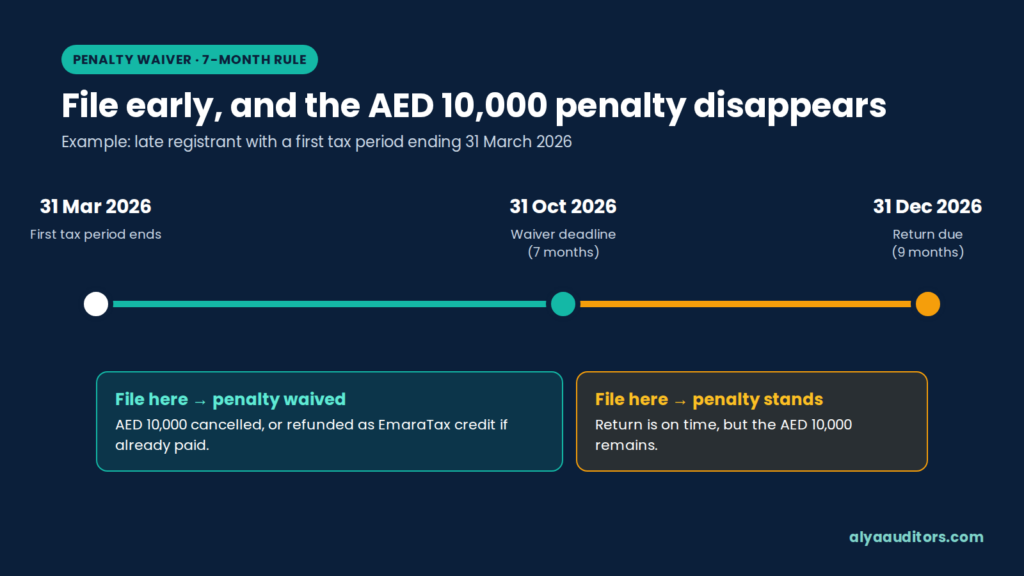
The waiver is automatic. There is no separate application form:
- Penalty assessed but not paid — it is cancelled once you file within the window.
- Penalty already paid — the AED 10,000 is credited back to your EmaraTax account and can be offset against future tax liabilities.
- Not yet registered at all — register now, then file your first return within the seven-month window to stay eligible.
Worked example
A Dubai mainland LLC licensed in May 2023 missed its 31 July 2024 registration deadline and was assessed AED 10,000. Its first tax period runs 1 April 2025 to 31 March 2026.
| Filing date | Return status | AED 10,000 penalty |
|---|---|---|
| By 31 October 2026 (within 7 months) | On time | Waived or refunded as credit |
| 1 November – 31 December 2026 | On time (within 9 months) | Stands |
| After 31 December 2026 | Late | Stands, plus late filing penalties |
For this company, the difference between filing in October and filing in November is AED 10,000.
What the waiver does not cover
The waiver applies only to the late registration penalty, and only via the first return. It does not cancel late filing penalties, late payment penalties or record-keeping penalties. If your first return window has already passed, the penalty generally stands — though a reconsideration request may be possible in specific circumstances, and is worth reviewing with an adviser.
How to register for Corporate Tax on EmaraTax
Registration is free and done online through the FTA’s EmaraTax portal. A straightforward application usually takes under an hour to submit if your documents are ready.
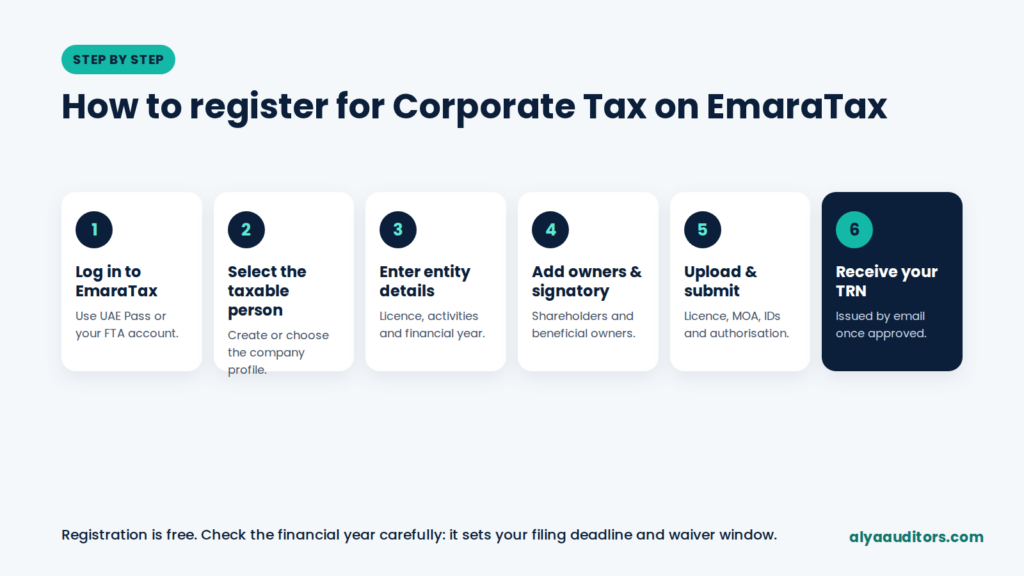
- Log in to EmaraTax with UAE Pass or your existing FTA account credentials.
- Select or create the taxable person profile for the company.
- Open the Corporate Tax registration application and complete the entity details, licence information, business activities and financial year.
- Add authorised signatory and owner details, including shareholders and ultimate beneficial owners.
- Upload supporting documents and submit. The FTA may raise queries; respond promptly to avoid rejection.
- Receive your Corporate Tax TRN by email once approved, and record it with your finance and compliance files.
Documents you will typically need
- Valid trade licence(s), including all branches
- Memorandum and Articles of Association, or partnership agreement
- Passport and Emirates ID of the authorised signatory and owners
- Proof of authorisation (power of attorney or board resolution), if applying through a representative
- Contact details and registered address
- Financial year details and, for free zone entities, the relevant free zone authority information
Double-check the financial year you enter. It determines your first tax period — and therefore your filing deadline and your seven-month waiver window.
Common Corporate Tax registration mistakes
- Assuming registration depends on profit. It does not. The AED 375,000 threshold affects the tax rate, not the duty to register.
- Assuming free zone status means no registration. Every free zone company must register, including those planning to claim 0%.
- Waiting until the first return is due. By then the AED 10,000 penalty is usually already triggered — and the seven-month waiver window may be short.
- Entering the wrong financial year. An incorrect year-end shifts your tax period and can push you outside the waiver window without you noticing.
- Registering only one entity in a group. Each legal entity needs its own registration unless a tax group has been formed and approved.
- Ignoring a penalty notice. Unpaid penalties accumulate on your EmaraTax account and can block deregistration and liquidation later.
- Treating the TRN as the finish line. Registration starts your obligations: bookkeeping, financial statements, transfer pricing records where relevant, and annual returns.
How Alya Auditors can help
Whether you are registering a new company or trying to recover from a missed deadline, Alya Auditors’ UAE tax team handles the process end to end:
- Registration check — we confirm whether each entity in your structure needs to register and which deadline applies.
- EmaraTax registration — we prepare and submit the application, including free zone, branch and non-resident cases.
- Penalty recovery — if you were registered late, we map your seven-month waiver window and plan your first return so the AED 10,000 penalty is cancelled or refunded.
- First return readiness — bookkeeping review, financial statements and Small Business Relief or Qualifying Free Zone Person assessments, so your first filing is accurate and on time.
Need help with Corporate Tax registration? Speak to our UAE tax team. Book a free consultation with Alya Auditors and find out exactly where your business stands — before the next deadline does it for you.
Frequently asked questions
Is Corporate Tax registration mandatory for all UAE companies?
Yes. Every resident company, including free zone companies, must register with the FTA and obtain a Corporate Tax TRN, regardless of turnover or profit.
What is the deadline for Corporate Tax registration for a new company?
A company incorporated in the UAE on or after 1 March 2024 must submit its registration application within three months of incorporation.
What is the penalty for late Corporate Tax registration in the UAE?
A fixed administrative penalty of AED 10,000, applied once per taxable person that misses its registration deadline.
Can the late registration penalty be waived?
Yes. The AED 10,000 penalty is waived automatically if you file your first Corporate Tax return or annual declaration within seven months of the end of your first tax period. If already paid, it is credited back to your EmaraTax account.
Do free zone companies need to register for Corporate Tax?
Yes. Free zone companies are resident taxable persons and must register, even if they expect to qualify for the 0% rate.
Do I need to register if my profit is below AED 375,000?
Yes. Profit below AED 375,000 is taxed at 0%, but registration is still required.
Do individuals need to register for Corporate Tax?
Only if they conduct a business or business activity in the UAE with turnover above AED 1 million in a calendar year. Resident individuals must apply by 31 March of the following year.
Is my VAT TRN the same as my Corporate Tax TRN?
No. VAT and Corporate Tax are separate registrations, even though both are managed through EmaraTax.
This article is general guidance based on FTA publications as of October 2026 and is not tax advice. Rules and initiatives can change; confirm your position with a qualified adviser.

Keep reading


Ready to Start?
Talk to a UAE compliance expert
Book a free, no-obligation consultation with ALYA Nexus Auditing.
Book Free Consultation ↗