
UAE Electronic Record-Keeping 2026: FTA Rules, Updated
 October 23, 2026
9 min read
Keeping tax records electronically in the UAE: the 2026 rules, updated for October’s e-invoicing changes
UAE businesses can keep their tax records fully electronically, but two decisions issued in 2026 have changed what that takes. FTA Decision No. 4 of 2026 tightened how records must be kept: complete, identical to the original, legible, and open to the FTA on request. Ministerial Decision No. 197 of 2026 then loosened where e-invoice data must be kept, removing the rule that it stay inside the UAE.
Put simply: format and access got stricter, location got looser. This guide brings both together so you can check your own set-up against the rules as they stand today.
The rules in one place
| Question | Short answer | Where it comes from |
| Can we keep records only in electronic form? | Yes, if each copy is complete, identical to the original, legible and accessible to the FTA | FTA Decision No. 4 of 2026 (in force 30 July 2026) |
| Can the FTA ask to see the system itself? | Yes. Access covers the system where the records are stored, not just exported files | FTA Decision No. 4 of 2026 |
| Must e-invoice data be stored in the UAE? | No, since 1 October 2026. It must be retained and producible on request | Ministerial Decision No. 197 of 2026, amending Article 11 of Decision No. 243 of 2025 |
| How long must we keep records? | Generally 5 years; 7 for real estate records and Corporate Tax; longer during audits | Tax Procedures Law and Cabinet Decision No. 74 of 2023; Corporate Tax Law |
| If our accountant or a provider holds the books, who is responsible? | You are. Outsourcing the storage does not outsource the duty | FTA Decision No. 4 of 2026 |
If you read only one line of this guide, make it this one: the FTA’s test is whether you can produce the full, original record quickly, not whether you have a folder of PDFs.
What “complete and identical” means for a scanned record

FTA Decision No. 4 of 2026 accepts two kinds of copy: an electronic copy and a photocopy. Either way, the copy must carry every detail of the original. For scanned documents, that translates into four working rules:
- Every page, in the original order. A partial scan, such as page one of a three-page contract, does not count.
- Readable on a screen. The resolution has to keep stamps, signatures, small print and handwritten notes legible.
- Colour is optional, legibility is not. A black-and-white copy of a coloured original is acceptable if nothing is lost.
- Paper copies must last. If you keep photocopies, the ink and paper must not fade before the retention period ends.
The practical risk sits with older archives. Supplier invoices scanned on a phone, cropped receipts and single-page captures made before 30 July 2026 may be saved, but they may not meet today’s standard. If an original is still in a box, keep it until you have checked the copy.
An e-invoice is not the same as an electronic record
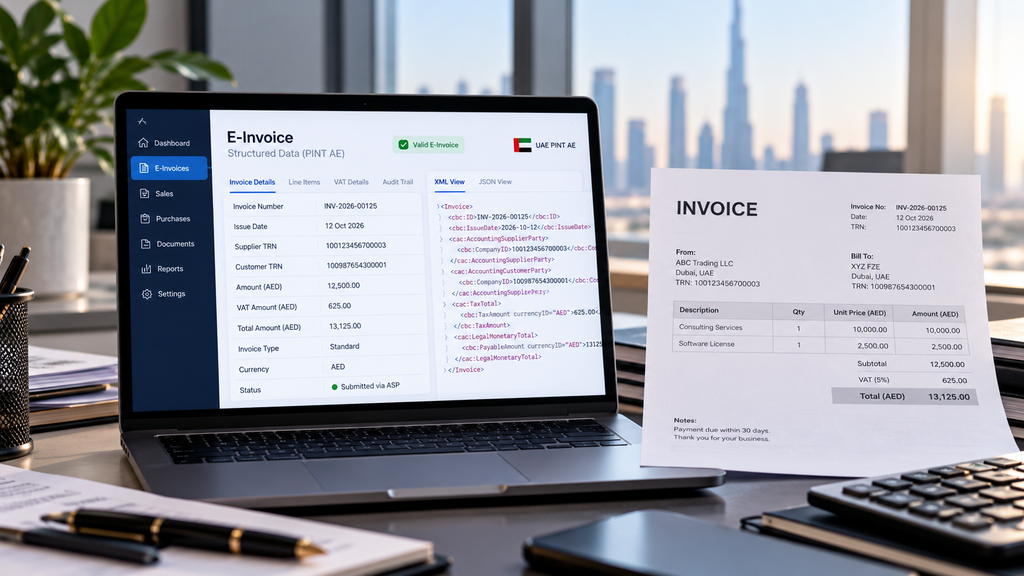
This is where many finance teams mix things up. An electronic record can be a scan of a paper document. An e-invoice, under the UAE system, is structured data exchanged between businesses through Accredited Service Providers on the Peppol network, using the UAE’s PINT AE format.
That difference matters for your archive:
- For e-invoices, the data file is the invoice. Keep the structured data, not only the PDF your ERP prints from it.
- The PDF is a readable view. Useful for staff, but it does not replace the e-invoice data if the FTA asks.
- Scanned documents, contracts, customs papers and receipts still fall under Decision No. 4’s rules for copies.
Your record-keeping policy should name both kinds of record and say where each one lives.
What “accessible to the FTA” looks like in practice
The Decision lets the FTA ask for access to the system where your records are kept. Where those records are protected by passwords or encryption, published summaries indicate the business must provide that access. The software is rarely the weak point. The weak points are usually people and ownership:
- the only admin login belongs to someone who has left;
- the accounting subscription is in the outside accountant’s name, not the company’s;
- the two-factor code goes to one person’s phone;
- supporting documents sit in a personal email inbox or cloud drive;
- a plan was downgraded and older years became read-only or were archived.
The fix is straightforward: the company owns every account, at least two named people hold admin rights, and there is a written note of who holds which credentials. If an outside firm keeps your books, your contract should say the data is yours and must be returned in full if the engagement ends.
Audit trails: good practice, not yet a prescribed format
Decision No. 4 does not set a technical format for system logs. Even so, a record that can be edited without trace is hard to defend as “identical to the original.” In an FTA review, you want to be able to show for any transaction:
- who created it, and who changed, voided or deleted it;
- when each change happened;
- what the values were before and after;
- which source document supports it;
- whether it was changed after the VAT return for that period was filed.
Check one thing in particular: can the log be exported? A trail you can only see on screen is hard to hand over.
Storing records outside the UAE after October 2026
From 1 October 2026, the e-invoicing rules no longer require e-invoice data to be stored in the UAE. That does not mean every record can move abroad without thought. Before you host or move records overseas, work through four questions:
- Is it e-invoice data? The tax rule is now location-neutral. Retention and on-request access still apply.
- Does it contain personal data? Customer and employee names, addresses and contact details bring in the UAE Personal Data Protection Law, or the DIFC and ADGM regimes for entities there.
- Are you in a regulated sector? Banks, insurers and healthcare providers may face separate data residency rules from their regulators.
- Can you still produce it fast? If retrieving a past period depends on a vendor’s support desk in another time zone, the storage location is a compliance risk, whatever the rules allow.
If all four answers are comfortable, overseas hosting is a legitimate choice. If any is uncertain, keep a UAE-held copy until it is resolved.
How long to keep each type of record
| Record type | Minimum period | Counted from |
| General tax records, including VAT | 5 years | End of the tax period they relate to |
| Real estate records | 7 years | End of the calendar year the record was created |
| Corporate Tax records | 7 years | End of the tax period |
| Any record under tax audit or dispute | Plus 4 years | End of the normal period |
| Records linked to a voluntary disclosure made in year five | Plus 1 year | Date of the disclosure |
Source: Tax Procedures Law, its Executive Regulation (Cabinet Decision No. 74 of 2023) and the Corporate Tax Law. Some older VAT guidance still quotes longer periods for real estate and capital assets. Where a record falls under more than one rule, or you are unsure, keep it for the longest period that could apply.
The 48-hour retrieval drill
The best way to know whether your records would pass an FTA request is to try one. We suggest this drill once a year, and again after any system change:
- Pick a period at random, ideally three or four years old, so you test the archive and not just the live system.
- Choose 15 transactions across sales, purchases, credit notes, an intercompany charge and a fixed asset.
- Give the team 48 hours to produce, for each one: the full original document, the e-invoice data where relevant, the ledger entry, and the change log.
- Mark each item pass or fail on completeness, legibility, and whether it was found without help from an outside vendor or a former employee.
- Fix the failures and write down the fix, then repeat the items that failed.
A business that passes this drill comfortably is in a strong position. One that cannot find a three-year-old purchase invoice in two days has found its risk before the FTA does.
Gaps we see most often
- Purchase invoices that live only as email attachments.
- Scans made on phones, missing pages or cut off at the edges.
- Books kept in the accountant’s own software account.
- Voided invoices that disappear from reports instead of showing as voided.
- No written retention policy, or one that predates Corporate Tax and e-invoicing.
- Customs and logistics documents held by a freight forwarder and never copied back.
Frequently asked questions
Can a UAE business go completely paperless?
Yes. Electronic copies are accepted as long as they are complete, identical to the original, legible on screen and available to the FTA on request.
Do we still need to keep e-invoice data on UAE servers?
Not under the e-invoicing rules, since Ministerial Decision No. 197 of 2026 took effect on 1 October 2026. You must still keep the data for the full retention period and produce it when asked. Data protection and sector rules may still limit where personal or regulated data can go.
Is a PDF of an invoice enough?
For a scanned paper document, a complete and legible PDF can be a valid electronic copy. For an e-invoice, no: the structured data exchanged through your ASP is the invoice, and that is what you need to keep.
Our accountant keeps our books. Who is liable if records are missing?
Your business. You can appoint a third party to hold your records, but the duty to keep them complete and accessible stays with you.
Can the FTA ask for our system login?
The FTA can ask for access to the system where records are stored. Where records are password-protected or encrypted, plan on having to provide that access.
Does using Zoho Books, Xero or another cloud tool make us compliant?
Not by itself. Compliance depends on who owns the account, how long data is kept, whether change logs can be exported, and whether e-invoices flow through an ASP.
How Alya Auditors can help
Alya Auditors helps UAE businesses review their record-keeping against FTA Decision No. 4 of 2026 and the updated e-invoicing rules. We can run the 48-hour retrieval drill with your team, review where your records and e-invoice data are hosted, and set up a retention policy that covers VAT, Corporate Tax and e-invoicing in one place. [Cristus: add CTA link.]
This article is general information and not legal or tax advice for any specific business. Last reviewed: 21 October 2026.
References
- Ministerial Decision No. 243 of 2025 on the Electronic Invoicing System (Ministry of Finance)
- FTA Decision No. 4 of 2026: summary of requirements (replace with the FTA’s own page when linking)
- Cabinet Decision No. 74 of 2023 retention periods, PwC summary
- UAE amends e-invoicing regulations as implementation deadline draws closer (The National, 19 October 2026)

Ready to Start?
Talk to a UAE compliance expert
Book a free, no-obligation consultation with ALYA Nexus Auditing.
Book Free Consultation ↗