
Small Business Relief UAE 2026: Who Qualifies & Key Rules
 October 7, 2026
9 min read
October 7, 2026
9 min read
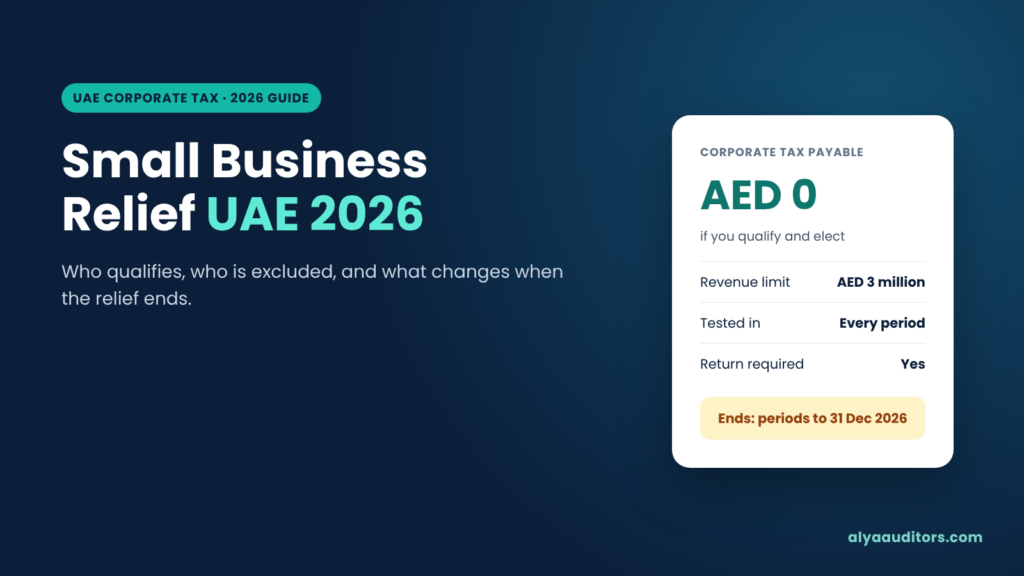
Small Business Relief lets an eligible UAE business pay no Corporate Tax for a tax period — but it is not automatic, it is not available to everyone under AED 3 million, and it ends with tax periods closing on 31 December 2026.
The most common misunderstanding is simple: “If my revenue is below AED 3 million, I qualify.” In reality, the relief has several conditions. Revenue must stay within the limit in the current period and every previous period. Qualifying Free Zone Persons and members of large multinational groups cannot use it at all. And you must actively elect for it in your Corporate Tax return.
The Federal Tax Authority (FTA) reinforced this in August 2026, reminding businesses that eligibility for relief does not remove the obligation to register, keep records and file a return on time.
This guide explains how Small Business Relief works, who qualifies, who is excluded, what you give up by electing, and what changes once the relief ends.
How Small Business Relief works
If you elect for Small Business Relief, your business is treated as having no taxable income for that tax period. That means no Corporate Tax is payable — even if your profit is above AED 375,000.
The relief is set out in Article 21 of Federal Decree-Law No. 47 of 2022 and Ministerial Decision No. 73 of 2023. It is an election, made period by period, not a permanent status.
What you still have to do
Electing for relief reduces your tax to zero. It does not reduce your compliance obligations. You must still:
- Register for Corporate Tax and hold a Corporate Tax TRN.
- File a Corporate Tax return within nine months of your tax period end. Businesses that elect relief can file a simplified return with less information.
- Keep records of transactions, assets (including acquisitions and disposals), liabilities, and shares or ownership interests held at the end of the period.
- Be able to prove your revenue for the current period and every earlier period, because that is how eligibility is tested.
Revenue, not profit
The AED 3 million test is based on revenue — your total income from the business before expenses — not profit. A business with AED 3.2 million in sales and a small margin does not qualify, even if its profit is only AED 200,000.
Who qualifies for Small Business Relief?
A business can elect for Small Business Relief only if it meets all of these conditions:

- It is a UAE Resident Person. This covers mainland companies and individuals doing business in the UAE. Non-residents, including foreign companies with a UAE Permanent Establishment, cannot elect.
- Revenue is AED 3 million or less in the current tax period.
- Revenue was AED 3 million or less in every previous tax period. This is the condition most businesses overlook. Exceed the limit once, and you lose eligibility for every later period — even if revenue falls back below AED 3 million.
- The tax period ends on or before 31 December 2026.
- It is not in an excluded category (see the next section).
- It elects for relief in its Corporate Tax return for that period.
Example: the “previous periods” trap
The FTA’s own guidance gives this scenario. A business earns AED 4.3 million in its first tax period and AED 1.9 million in its second. Even though the second period is well under the limit, the business cannot claim relief, because revenue exceeded AED 3 million in a previous period.
What about individuals?
A resident individual whose business turnover exceeds AED 1 million becomes subject to Corporate Tax. If that turnover stays at or below AED 3 million, the individual can generally elect for Small Business Relief in the same way as a company.
Who cannot claim Small Business Relief?
Some businesses are excluded regardless of revenue:
| Excluded | Why it matters |
|---|---|
| Qualifying Free Zone Persons (QFZPs) | A free zone company enjoying the 0% QFZP regime cannot also claim Small Business Relief. It must choose: meet the QFZP conditions, or give up QFZP status to elect for relief. |
| Members of a Multinational Enterprise (MNE) group | Any UAE entity in a group with consolidated revenue above AED 3.15 billion is excluded, even if the UAE entity itself is small. |
| Non-residents | Only Resident Persons can elect, so foreign companies with a UAE Permanent Establishment or nexus are excluded. |
| Businesses that exceeded AED 3 million before | One period over the limit removes eligibility for all later periods. |
A note for free zone companies
A free zone company that does not meet the QFZP conditions is treated like any other resident business. If its revenue stays within AED 3 million in every period, it may be able to elect for Small Business Relief instead. The right choice depends on your income mix and long-term plans, so it is worth reviewing before filing.
Small Business Relief ends with 2026
Small Business Relief applies only to tax periods that start on or after 1 June 2023 and end on or before 31 December 2026. Unless the Ministry of Finance announces an extension, there is no relief for any period ending after that date.
Your financial year decides your last eligible period:
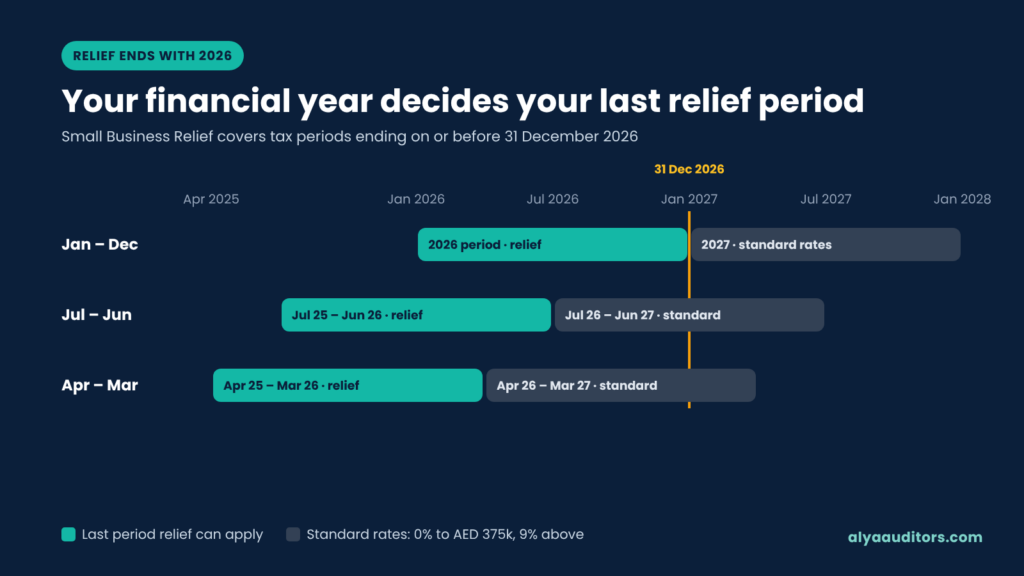
| Financial year | Last period eligible for relief | First period without relief |
|---|---|---|
| January – December | 1 Jan – 31 Dec 2026 | 1 Jan – 31 Dec 2027 |
| July – June | 1 Jul 2025 – 30 Jun 2026 | 1 Jul 2026 – 30 Jun 2027 |
| April – March | 1 Apr 2025 – 31 Mar 2026 | 1 Apr 2026 – 31 Mar 2027 |
This means some businesses are already in their first period without relief. A company with a July–June year is now in a period ending 30 June 2027, so it cannot elect for relief for that period.
What happens after relief ends
Once relief no longer applies, the standard Corporate Tax rates apply to taxable profit: 0% on the first AED 375,000 and 9% above that. Many small businesses will still pay little or no tax — but they will need proper financial statements, accurate tax adjustments and a full return to show it.
What you give up by electing for relief
Small Business Relief is not always the best choice. When you elect for it, other Corporate Tax reliefs, exemptions and deductions do not apply for that period. In particular:
- Tax losses. Losses incurred in a period where you elect for relief cannot be carried forward to reduce future taxable income. A loss-making start-up may be better off not electing, so it can use those losses once relief ends in 2027.
- Disallowed net interest expenditure. Interest that would normally be carried forward under the interest limitation rules is also lost for relief periods.
- Transfer pricing documentation. You do not need to prepare a disclosure form, master file or local file. However, transactions with related parties and connected persons must still be at arm’s length.
Should you elect?
For a profitable business under AED 3 million, relief is usually the simpler and cheaper option. For a business making losses, or one expecting to grow quickly past AED 3 million, it can make sense to file normally and keep those losses for later. Run the numbers for both options before you submit.
Don’t split your business to stay under AED 3 million
The law specifically targets businesses that split one operation into several smaller entities so each stays below the AED 3 million limit.
If the FTA concludes that a business has been artificially separated mainly to claim Small Business Relief, it can deny the relief and apply the General Anti-Abuse Rule under Article 50 of the Corporate Tax Law. Administrative penalties can also apply.
Warning signs the FTA may look at include:
- Several licences with the same owners carrying on the same activity
- Shared staff, premises, customers or bank accounts across entities
- New entities created shortly before revenue would have crossed AED 3 million
- Revenue split in a way that has no commercial reason other than tax
Genuine group structures are fine. The question is whether each business has a real commercial purpose of its own.
How to claim Small Business Relief
There is no separate application. You elect for relief inside your Corporate Tax return on EmaraTax:
- Confirm eligibility — resident status, not a QFZP or large MNE member, and revenue at or below AED 3 million in this and every previous period.
- Prepare your revenue figures from your accounting records or financial statements, and keep the supporting records.
- Log in to EmaraTax and open the Corporate Tax return for the tax period.
- Select the Small Business Relief election. EmaraTax then shows the simplified return.
- Complete and submit the return by the deadline: nine months after your tax period ends.
A return filed late still attracts late filing penalties, even if no tax is due.
Three quick scenarios
| Business | Revenue history | Can it elect? |
|---|---|---|
| Dubai mainland consultancy | AED 1.2m (2024), AED 2.6m (2025) | Yes, for both periods, if it elects in each return |
| Retail trader | AED 3.4m (2024), AED 2.8m (2025) | No — exceeded AED 3m in 2024 |
| IFZA company meeting QFZP conditions | AED 900k (2025) | No — QFZPs are excluded; it uses the QFZP regime instead |
Common Small Business Relief mistakes
- Assuming relief is automatic. It must be elected in each return.
- Testing only the current year. Every previous period counts.
- Using profit instead of revenue. The AED 3 million limit is a revenue test.
- Not filing because no tax is due. A return is still required, and late filing penalties still apply.
- Claiming relief as a Qualifying Free Zone Person. The two regimes cannot be combined.
- Electing while making losses. Those losses are lost for future use.
- Planning for relief beyond 2026. Periods ending after 31 December 2026 are not covered.
How Alya Auditors can help
Alya Auditors helps UAE businesses decide whether Small Business Relief is right for them and claim it correctly:
- Eligibility review — revenue history, resident status, free zone and group position.
- Relief vs. standard filing comparison — including the value of losses you would give up.
- Corporate Tax return preparation — simplified or full returns, filed on EmaraTax before the deadline.
- Post-2026 readiness — financial statements and tax adjustments for your first period without relief.
Find out whether your business may qualify — request a Corporate Tax review. Alya Auditors’ UAE tax team will check your eligibility and tell you which filing option saves you more.
Frequently asked questions
What is Small Business Relief in the UAE?
It is a Corporate Tax relief that lets an eligible resident business with revenue of AED 3 million or less be treated as having no taxable income for a tax period, so no Corporate Tax is payable.
Does every business under AED 3 million qualify?
No. Revenue must be AED 3 million or less in the current and all previous tax periods, the business must be a UAE resident, and Qualifying Free Zone Persons and members of MNE groups with revenue above AED 3.15 billion are excluded.
When does Small Business Relief end?
It applies to tax periods ending on or before 31 December 2026. Periods ending after that date are not covered unless the Ministry of Finance announces an extension.
Do I still need to file a Corporate Tax return if I claim relief?
Yes. You must elect for relief in your Corporate Tax return and file it within nine months of your tax period end. Eligible businesses can use a simplified return.
Can a free zone company claim Small Business Relief?
Only if it is not a Qualifying Free Zone Person and meets the other conditions. A QFZP cannot claim the relief.
What happens to my tax losses if I elect for relief?
Losses incurred in a period where you elect for relief cannot be carried forward to future periods.
Is the AED 3 million limit based on revenue or profit?
Revenue. Profit levels do not affect eligibility.
This article is general guidance based on FTA and Ministry of Finance publications as of October 2026 and is not tax advice. Confirm your position with a qualified adviser before filing.


Ready to Start?
Talk to a UAE compliance expert
Book a free, no-obligation consultation with ALYA Nexus Auditing.
Book Free Consultation ↗