
Is Audit Mandatory for All Companies in Dubai? The Complete 2026 Guide
 July 18, 2026
14 min read
July 18, 2026
14 min read
Is Audit Mandatory for All Companies in Dubai? The Complete 2026 Guide
By Alya Auditors | Chartered Accountants & Approved Auditors, Dubai, UAE
Every business owner in Dubai eventually asks the same question: do I actually need an audit? The answer is not a simple yes or no. It depends on where your company is registered, how much revenue it earns, and which authority issued your trade licence.
At Alya Auditors, we work with mainland companies, free zone entities and offshore structures across Dubai, Abu Dhabi and Sharjah every day, and this is one of the most common compliance questions we hear from founders, CFOs and investors. This guide breaks down exactly who must have an audit, who is exempt, and what happens if you ignore the requirement.
Quick Answer:No, audit is not mandatory for every company in Dubai. Free zone companies (like DMCC, JAFZA, DIFC) almost always require annual audited financial statements for licence renewal, regardless of revenue. Mainland and free zone companies alike must be audited once revenue exceeds AED 50 million under UAE Corporate Tax law. Free zone companies that are Qualifying Free Zone Persons must always be audited to keep their 0% tax rate, no matter their revenue. Small businesses below these thresholds are generally exempt from statutory audit, but not from bookkeeping.
Not sure which category your company falls into? Alya Auditors can confirm your exact audit obligation and book your audit in the same call, no guesswork required.
Table of Contents
- What Does “Mandatory Audit” Mean in the UAE?
- Is Audit Mandatory for All Companies in Dubai? The Short Answer
- Mainland Companies: Audit Requirements Under UAE Law
- Free Zone Companies: Why Audits Are Almost Always Mandatory
- Offshore Companies and Audit Obligations
- UAE Corporate Tax Law and Audited Financial Statements
- VAT, FTA Tax Audits and Record-Keeping Duties
- Who Is NOT Required to Have a Mandatory Audit?
- Dubai vs Abu Dhabi vs Sharjah: Do Rules Differ by Emirate?
- What Happens If You Skip a Mandatory Audit?
- How to Prepare Your Company for a UAE Audit
- Why Work With Alya Auditors
- Frequently Asked Questions
What Does “Mandatory Audit” Mean in the UAE?
A mandatory audit is an independent examination of a company’s financial statements carried out by a licensed external auditor, resulting in a signed audit report that confirms whether the accounts give a true and fair view of the business.
In the UAE, this obligation can come from three separate directions, and a company can be caught by more than one at the same time:
- Free zone company law – most free zone authorities require audited accounts for licence renewal, regardless of size.
- UAE Corporate Tax Law – audited financial statements are required once revenue crosses a set threshold, or if the entity is a Qualifying Free Zone Person.
- Sector-specific regulation – banks, insurance companies, financial services firms and NGOs face additional audit rules from their regulators.
Statutory Audit vs Internal Audit vs Tax Audit
These three terms get mixed up constantly, so it helps to separate them clearly.
- Statutory audit: A legally required annual audit of financial statements, performed by an external, licensed auditor.
- Internal audit: A voluntary, ongoing review of internal controls and risk, usually done by an in-house team or outsourced provider, not tied to a legal deadline.
- Tax audit: A review carried out by the Federal Tax Authority (FTA) to check VAT or Corporate Tax compliance, separate from a company’s own statutory audit.
Is Audit Mandatory for All Companies in Dubai? The Short Answer
No. Audit is not a blanket requirement for every single company in Dubai. The obligation depends heavily on your business structure:
- Free zone companies: Audit is required in almost every free zone, as a condition of licence renewal, no matter the revenue size.
- Mainland LLCs: Not automatically required by the Commercial Companies Law for every small business, but becomes mandatory once Corporate Tax thresholds are triggered.
- Qualifying Free Zone Persons (QFZPs): Audit is mandatory regardless of revenue, because it is a condition for keeping the 0% Corporate Tax rate.
- Large private companies and PJSCs: Audit has long been a Commercial Companies Law requirement for joint stock companies and larger private entities.
- Small mainland businesses below the AED 50 million revenue threshold: Generally exempt from mandatory statutory audit for Corporate Tax purposes, though good bookkeeping is still compulsory.
In short, the safest assumption for any founder in Dubai is this: if you hold a free zone licence, or your revenue is approaching AED 50 million, treat an annual audit as compulsory rather than optional.
Mainland Companies: Audit Requirements Under UAE Law
Mainland companies are licensed by the Department of Economy and Tourism (Dubai) or the equivalent Economic Department in other emirates, and operate under the UAE Commercial Companies Law (Federal Decree-Law No. 32 of 2021).
LLCs and Audited Financial Statements
Historically, many small and medium mainland LLCs were not required to submit audited accounts every year unless a bank, investor or the Economic Department specifically asked for them. That picture has changed with the introduction of Corporate Tax.
Today, a mainland LLC must prepare audited financial statements once its revenue passes the AED 50 million threshold in a tax period, since this is a Corporate Tax requirement that applies regardless of licence type, as confirmed by the UAE Ministry of Finance.
License Renewal and Local Requirements
Some mainland activities and larger companies are asked to submit audited financials as part of licence renewal or when applying for certain approvals, tenders or bank facilities, even below the Corporate Tax threshold. It is common practice for growing SMEs to commission a voluntary statutory audit early, backed by clean bookkeeping and accounting records, simply because banks, landlords and investors ask for one.
Free Zone Companies: Why Audits Are Almost Always Mandatory
Free zones operate under their own company regulations, separate from the mainland Commercial Companies Law, and almost every major free zone authority in the UAE requires an annual audit in free zones as a condition of keeping the trade licence active.
DMCC Audit Requirement
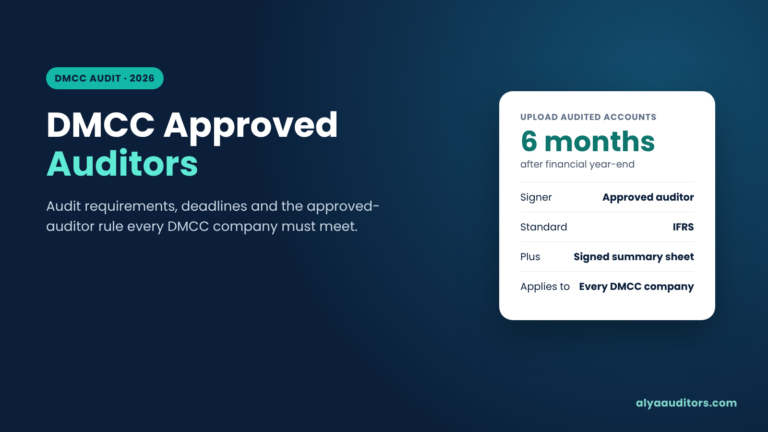
The Dubai Multi Commodities Centre requires every registered company, including dormant ones, to submit audited financial statements each year through the DMCC member portal, generally within a set number of days after financial year-end. Missing this deadline can block licence renewal and trigger fines, regardless of the company’s revenue or trading activity. Our DMCC audit regulations guide and our list of DMCC-approved auditors cover this in more detail.
JAFZA, DIFC, ADGM and Other Free Zones
The same pattern holds across Jebel Ali Free Zone (JAFZA), the Dubai International Financial Centre (DIFC), Abu Dhabi Global Market (ADGM), RAKEZ, Sharjah Airport International Free Zone (SAIF Zone), Hamriyah Free Zone and most other UAE free zones. Each authority sets its own submission window and approved auditor list, but the underlying principle is consistent: no audited accounts, no smooth licence renewal. See our DMCC vs JAFZA vs IFZA comparison for a side-by-side breakdown of deadlines.
Consequences of Not Submitting Audited Financials
- Trade licence renewal delayed or rejected
- Administrative fines and, in some free zones, escalating penalties
- Restrictions on the company’s online portal account
- Risk to banking relationships and credit facilities
- Loss of Qualifying Free Zone Person status and the 0% Corporate Tax rate, for QFZPs
If you have already missed a submission window, read our guide on what happens when you miss a free zone audit deadline before contacting the authority.
Offshore Companies and Audit Obligations
Offshore companies, such as those registered under JAFZA Offshore or RAK ICC, are typically not permitted to carry out business inside the UAE and exist mainly for holding assets, shares or intellectual property. Many offshore jurisdictions do not demand a public annual audit, but this does not remove the underlying legal duty to maintain proper accounting records.
If an offshore entity becomes part of a group structure that includes a taxable UAE mainland or free zone company, audit requirements can flow through from Corporate Tax or from the parent entity’s own compliance obligations.
UAE Corporate Tax Law and Audited Financial Statements
Corporate Tax has become the single biggest driver of audit obligations in the UAE since it took effect. Under Ministerial Decision No. 84 of 2025, which built on the earlier Ministerial Decision No. 82 of 2023, the rules on audited financial statements are now clearer than ever. Full details are published by the UAE Ministry of Finance and on the official UAE Government portal.
Who Must Prepare Audited Financials Under Corporate Tax
- Any standalone taxable person whose revenue exceeds AED 50 million in a tax period
- Every Qualifying Free Zone Person (QFZP), regardless of revenue
- Every Tax Group, which must prepare audited special purpose aggregated financial statements
- Non-resident persons, but only revenue linked to a UAE permanent establishment or nexus counts toward the AED 50 million threshold
Free Zone Persons and the 0% Corporate Tax Rate
A Qualifying Free Zone Person can benefit from a 0% Corporate Tax rate on qualifying income, but only if it meets several conditions, and maintaining audited financial statements is one of them. Skipping the audit does not just create a compliance gap, it can put the entire 0% tax position at risk.
Businesses that qualify for Small Business Relief, generally those with revenue of AED 3 million or less in a tax period, are not automatically required to prepare audited financials for Corporate Tax purposes, but should still keep clean, audit-ready books in case relief eligibility changes. Our Corporate Tax registration service can confirm exactly where your business stands.
VAT, FTA Tax Audits and Record-Keeping Duties
VAT registration does not, by itself, force every company to appoint an external auditor. However, the Federal Tax Authority can launch its own tax audit at any time to verify VAT returns, input tax claims and record-keeping.
Every VAT-registered business must keep accounting records, tax invoices and supporting documents for the period required by law, so that it can respond to an FTA audit without delay. Businesses that already commission an annual statutory audit typically find FTA tax audits far smoother, because their books are already in order.
Who Is NOT Required to Have a Mandatory Audit?
Some UAE businesses fall outside the mandatory audit net, at least for now. This generally includes:
- Sole establishments and small mainland businesses below the AED 50 million Corporate Tax revenue threshold, and not part of a Tax Group
- Businesses correctly claiming Small Business Relief under Corporate Tax law
- Certain civil companies and small partnerships with no free zone licence and no bank or investor requiring an audit
Even where an audit is not legally compulsory, many owners still choose a voluntary audit before seeking a bank loan, onboarding an investor, applying for a tender, or preparing to sell the business.
Dubai vs Abu Dhabi vs Sharjah: Do Rules Differ by Emirate?
Corporate Tax audit thresholds are federal, so they apply the same way in Dubai, Abu Dhabi, Sharjah and every other emirate. What differs by emirate, and by free zone, is the local licensing authority’s own audit and reporting requirements.
- Dubai: Home to DMCC, JAFZA, DIFC and dozens of other free zones, each with its own audit submission portal and deadline
- Abu Dhabi: ADGM enforces strict audited financial statement filing, alongside Abu Dhabi mainland Economic Department requirements
- Sharjah: SAIF Zone, Hamriyah Free Zone and Sharjah Media City each set their own annual audit submission rules
A company with branches in more than one emirate should map out every licence it holds and check each authority’s audit deadline separately, rather than assuming one filing covers the whole group.
What Happens If You Skip a Mandatory Audit?
Ignoring a mandatory audit rarely stays a paperwork issue for long. In our experience advising clients across Dubai and the wider UAE, the most common consequences are:
- Trade licence renewal is refused until audited accounts are submitted
- Administrative fines from the free zone authority or regulator
- Loss of Qualifying Free Zone Person status and the associated 0% Corporate Tax rate
- Banks pausing or declining credit facilities without audited financials
- Reduced credibility with investors, partners and government tender panels
The safest approach is to treat the audit timeline as a fixed date in the business calendar, the same way VAT and Corporate Tax filing deadlines are treated, rather than something to deal with only once a renewal notice arrives. For a real breakdown of the fallout, see what happens if you miss your free zone audit deadline.
How to Prepare Your Company for a UAE Audit
A smooth audit almost always comes down to preparation. Companies that organise their records early avoid last-minute stress and unnecessary fees.
Documents Auditors Typically Require
- Trade licence and Memorandum of Association
- Bank statements for the full financial year
- Sales invoices, purchase invoices and expense receipts
- Payroll records and WPS reports
- Fixed asset register and depreciation schedule
- VAT returns and Corporate Tax registration details
- Prior year audited financial statements, if available
Choosing an Approved Auditor
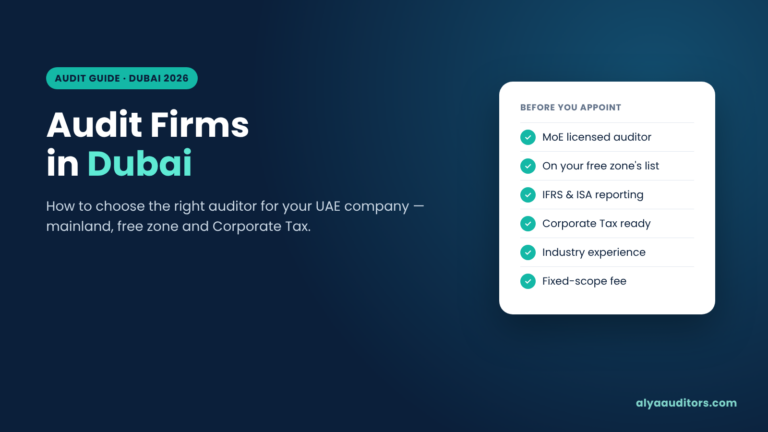
Not every accountant can sign a statutory audit report. Your auditor must be registered with the UAE Ministry of Economy and, for free zone companies, appear on that specific free zone’s approved auditor list. Confirming this before engagement avoids a rejected audit report and a repeat exercise. Our guide on how to choose an audit firm in Dubai walks through exactly what to check.
Why Work With Alya Auditors
Alya Auditors is a Dubai-based firm of chartered accountants and approved auditors, working with mainland, free zone and offshore companies across the UAE. Our team prepares audited financial statements that meet DMCC, JAFZA, DIFC, ADGM and Corporate Tax requirements, and we stay directly involved from bookkeeping review through to the final signed audit report.
We have supported businesses across trading, e-invoicing-driven sectors, professional services, hospitality and digital commerce, helping founders understand exactly which audit rules apply to their specific licence and revenue position, then closing the gap before a renewal deadline becomes a crisis.
- UAE Ministry of Economy approved auditors
- Listed with major Dubai free zone authorities, including DIFC and JAFZA
- End-to-end support: bookkeeping review, audit, Corporate Tax and VAT filing
- Fixed-fee audit packages for SMEs and startups; and support through to closure via our company liquidation team, if a wind-down is what your business needs
Ready to find out exactly what your company needs? Book a free audit consultation with Alya Auditors today and get a clear answer, in writing, on your mandatory audit obligations.
Frequently Asked Questions
Is audit mandatory for all companies in Dubai?
No. Free zone companies almost always need an annual audit for licence renewal. Mainland companies need one once revenue passes AED 50 million under Corporate Tax law, or if they are a Qualifying Free Zone Person, regardless of revenue.
Do small businesses in Dubai need an audit?
Small businesses below the AED 50 million Corporate Tax threshold, and not part of a Tax Group, are generally not required to have a mandatory statutory audit, though they must still keep proper accounting records and may need a voluntary audit for banking or investor purposes.
Is a DMCC company required to submit an audit every year?
Yes. DMCC requires all registered companies, including dormant ones, to submit audited financial statements annually through its member portal. Missing the deadline can delay or block trade licence renewal.
What is the revenue threshold for mandatory audit under UAE Corporate Tax?
A standalone taxable person must prepare audited financial statements once revenue exceeds AED 50 million in a tax period, under Ministerial Decision No. 84 of 2025. Qualifying Free Zone Persons and Tax Groups must be audited regardless of revenue.
Does a free zone company always need an audit, even with low revenue?
Generally yes, especially for Qualifying Free Zone Persons, since audited financial statements are one of the conditions for keeping the 0% Corporate Tax rate on qualifying income. Free zone authorities like DMCC and JAFZA also require audits as part of licence renewal, independent of revenue.
What happens if my company misses its mandatory audit deadline in the UAE?
Consequences typically include administrative fines, delayed or refused trade licence renewal, restricted authority portal access, and, for free zone companies, possible loss of Qualifying Free Zone Person status and its associated tax benefits.
Who can perform a statutory audit in the UAE?
Only auditors registered with the UAE Ministry of Economy can sign a statutory audit report. Free zone companies must also confirm their auditor appears on that specific free zone’s approved auditor list.
Conclusion
Audit is not mandatory for every single company in Dubai, but it is mandatory for far more businesses than most owners assume, especially since Corporate Tax came into effect. Free zone companies, Qualifying Free Zone Persons, Tax Groups, and any business crossing the AED 50 million revenue line all fall squarely within the requirement.
The safest move is to check your specific obligation against your licence type and revenue, well before a renewal deadline or tax filing forces the issue.
Talk to Alya Auditors today for a clear, written answer on your company’s mandatory audit obligations, and a fixed-fee proposal to get it done right the first time.

Keep reading

Ready to Start?
Talk to a UAE compliance expert
Book a free, no-obligation consultation with ALYA Nexus Auditing.
Book Free Consultation ↗