
How Consultants Can Increase Revenue With Compliance Services
 August 19, 2026
10 min read
August 19, 2026
10 min read
How Consultants Can Increase Revenue With Compliance Services
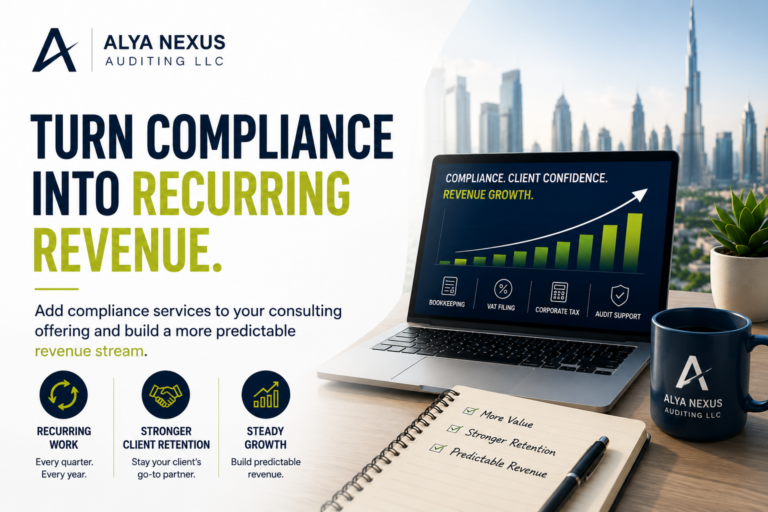
Consultants can increase revenue with compliance services because compliance work behaves differently from the advisory projects most consulting practices are built around: it recurs on a fixed calendar, it isn’t optional for the client, and it doesn’t compete on the same crowded pitch as strategy or transformation work.
Most consulting revenue is project-shaped. A client hires a consultant for a defined engagement — a market entry study, an HR restructuring, a process audit — and when the engagement ends, so does the invoice. The next quarter starts back at zero, chasing the next proposal.
Compliance services don’t work that way. A VAT return is due every quarter regardless of what else is happening in the business. A corporate tax filing is due every year. A statutory audit, an AML risk assessment, or a UBO declaration comes back on its own schedule, whether or not the client remembers to ask for it. That predictability is exactly what makes compliance an attractive line to add — not as a replacement for advisory work, but as the steady base underneath it.
This piece looks at what’s actually driving the opportunity, which compliance services add revenue without requiring a consultant to become a licensed auditor overnight, and how to structure the work so it doesn’t just add income but locks in the advisory relationship it sits alongside.
Quick Answer: Consultants increase revenue with compliance services by attaching recurring, mandatory work — VAT filing, corporate tax compliance, transfer pricing documentation, AML/UBO obligations, and statutory audit coordination — to advisory relationships they already have. UAE regulatory expansion (640,000+ businesses now in the Corporate Tax system, tighter penalties from April 2026, and a phased e-invoicing rollout through 2027) is pushing demand for this work higher, and consultants who don’t hold an audit license can still capture the revenue by partnering with an accredited firm to deliver the technical work under their own client relationship.
Table of Contents
- What “Compliance Services” Actually Means for a Consulting Practice
- Why Compliance Work Is a Different Revenue Model Than Project Consulting
- The UAE Regulatory Environment Is Pushing Compliance Demand Higher
- The Compliance Services Worth Adding First
- Where Consultants Hit a Capacity Wall — And How to Solve It Without Hiring
- Bundling Compliance Into Advisory Relationships You Already Have
- What This Means for Consultants Deciding Whether to Build This Line
- Why Partner With Alya Auditors
1. What “Compliance Services” Actually Means for a Consulting Practice
Compliance services cover the recurring, legally required work that keeps a business in good standing with a regulator: VAT and corporate tax filing, statutory audit, transfer pricing documentation, AML and UBO reporting, and licence renewals. None of it is optional for the client, and almost none of it depends on whether the business is growing, restructuring, or standing still.
For a consultant, that’s the distinction that matters. Advisory work is sold on a problem the client currently has. Compliance work is sold on an obligation the client always has — which is a fundamentally easier thing to keep billing for.
2. Why Compliance Work Is a Different Revenue Model Than Project Consulting
A typical advisory engagement has a start date, an end date, and a single invoice (or a short milestone series) in between. Pipeline has to be rebuilt constantly, because every completed project is a client relationship that goes quiet until the next need arises.
Compliance work replaces that pattern with a subscription-like cadence: quarterly VAT filings, an annual corporate tax return, a recurring audit engagement. The revenue is smaller per instance but far more predictable, and it keeps the consultant inside the client’s business year-round rather than only during active projects.
The Retention Effect Matters More Than the Fee
A consultant handling a client’s quarterly VAT filing has a standing reason to be in that client’s inbox every three months. That visibility is worth more than the filing fee itself — it’s the difference between being remembered when the client’s next strategic need comes up, and being one of several names they’d have to search for.
3. The UAE Regulatory Environment Is Pushing Compliance Demand Higher
More than 640,000 businesses were already enrolled in the UAE Corporate Tax system as of 2026, and that base keeps growing as newly registered companies reach their first filing cycle. Every one of them needs registration, annual filing, and — above the AED 375,000 profit threshold — an active compliance relationship with someone who understands the return.
Enforcement has tightened alongside that growth. A unified penalty regime under Cabinet Decision No. 129 of 2025 took effect on 14 April 2026, consolidating VAT and corporate tax penalties and raising the cost of a missed deadline or an undocumented position. Late corporate tax filings now carry a fixed AED 10,000 penalty on top of any tax due, with no reminder and no automatic grace period.
A phased e-invoicing rollout adds a further compliance layer through 2026 and 2027: businesses with revenue at or above AED 50 million must appoint an Accredited Service Provider by 31 July 2026 and go live by 1 January 2027, with SMEs following on 31 March 2027 and 1 July 2027. Details are tracked on the Federal Tax Authority’s EmaraTax platform.
None of this is a temporary spike. It’s a market where compliance obligations are multiplying faster than most consulting practices have built capacity to handle them — which is exactly the gap that turns into revenue for whoever fills it.
4. The Compliance Services Worth Adding First
Not every compliance service is worth building at once. A handful stand out for how directly they connect to work most consultants are already doing:
- VAT registration and quarterly filing — low technical barrier, immediate recurring revenue, and a natural add-on for any client already receiving bookkeeping or advisory support.
- Corporate tax registration and annual return preparation — nearly every UAE company now needs this, making it the single broadest-reach compliance service available.
- Transfer pricing documentation — Master File and Local File obligations apply above AED 200 million in related-party transactions, a threshold that catches more mid-market groups than owners expect.
- AML and UBO reporting — a recurring obligation for a wide range of licensed activities, frequently missed by businesses that don’t have anyone tracking the filing calendar.
- Statutory audit coordination — the one service on this list that legally requires a registered auditor’s signature, which is why it’s usually delivered through a partner rather than built in-house (more on this below).
5. Where Consultants Hit a Capacity Wall — And How to Solve It Without Hiring
Statutory audit is where most consulting practices stop, because only auditors registered with the Ministry of Economy’s Auditors Department can legally sign an audit report in the UAE. A management or HR consultant can’t simply add that capability by hiring one person — free zone approvals, technical audit standards, and ongoing licensing all sit behind it.
That’s not a reason to leave the revenue on the table. It’s a reason to partner rather than build. A consultant can originate the audit engagement, own the client relationship and the fee, and route the technical delivery to an accredited audit partner working under a white-label or referral arrangement. The client experience stays with the consultant; the regulatory capability comes from the partner.
We’ve covered the mechanics of this model in more detail in why small accounting firms should outsource audit work and how to scale an accounting practice without hiring — the same logic applies to any consulting practice weighing whether to build audit capability or partner for it, not just accounting firms.
6. Bundling Compliance Into Advisory Relationships You Already Have
The fastest way to add compliance revenue isn’t a new client acquisition push — it’s a conversation with clients already on the books. A business-setup consultant who helped a client incorporate is the natural first call when that same client needs corporate tax registration a year later. An HR consultant advising on payroll structuring is well placed to flag a VAT filing gap the client didn’t know existed.
Bundling works because the client already trusts the consultant’s judgment on one problem, which lowers the resistance to bringing a second, adjacent problem to the same person — rather than starting a vendor search from scratch for every new obligation that comes up.
7. What This Means for Consultants Deciding Whether to Build This Line
None of the forces behind this shift look temporary. Corporate tax isn’t being repealed, enforcement isn’t loosening, and e-invoicing is arriving in phases through 2027 regardless of what any individual practice decides to do about it. That makes compliance less of an optional add-on and more of a structural piece of what a consulting practice in the UAE is expected to offer.
The practical question isn’t whether to engage with compliance work — clients are going to need it whether or not their consultant offers it. The question is whether that revenue goes to the consultant already in the room, or to whichever firm the client finds when they go looking for it elsewhere.
9. Why Partner With Alya Auditors
Alya Auditors provides audit and assurance services and free zone-approved audits built for consultants who want to offer compliance services without becoming a licensed audit firm themselves — accredited delivery capacity a consulting practice can attach to its own client relationships.
Image Suggestions (For Publishing)
- Featured image: a consultant reviewing documents with a client, UAE office setting — alt text: “consultant offering compliance services to increase revenue”
- Section 3 (regulatory environment): a simple timeline graphic of 2026–2027 e-invoicing deadlines — alt text: “UAE e-invoicing compliance deadlines 2026 2027”
- Section 4 (services worth adding): an icon-based checklist of the five compliance services listed — alt text: “compliance services consultants can add for recurring revenue”
Use descriptive file names (e.g. consultant-compliance-services-revenue.jpg) rather than generic camera filenames.
Internal Linking Suggestions (For Publishing)
When this article goes live on alyaauditors.com, link the following existing pages within the body copy:
- Why Small Accounting Firms Should Outsource Audit Work — anchor: “why small accounting firms should outsource audit work” (Section 5)
- How to Scale an Accounting Practice Without Hiring — anchor: “how to scale an accounting practice without hiring” (Section 5)
- Why Audit Outsourcing Is Growing in the UAE — anchor: reference in Section 3 or a related-reading callout
- Audit and Assurance Service — anchor: “audit and assurance services” (Section 9)
- Audit in Free Zones — anchor: “free zone-approved audits” (Section 9)
Frequently Asked Questions
How do consultants increase revenue with compliance services?
By attaching recurring, legally mandatory work — VAT filing, corporate tax compliance, transfer pricing documentation, and audit coordination — to advisory relationships they already have, turning one-off project fees into a steadier, repeating revenue base.
Do I need an audit license to offer compliance services?
No, except for statutory audit itself, which legally requires a registered auditor’s signature. Most other compliance services — VAT, corporate tax filing, AML/UBO reporting — don’t require an audit license, and audit work specifically can be delivered through an accredited outsourcing partner.
Which compliance service should a consultant add first?
VAT registration and filing is typically the lowest-barrier starting point, since it has broad applicability and doesn’t require specialised licensing — corporate tax compliance is a close second given how many businesses now fall under the requirement.
Is compliance revenue reliable long-term?
The underlying drivers — corporate tax enrolment, tightening enforcement, and the phased e-invoicing rollout — aren’t temporary, which suggests compliance demand reflects a structural shift in the UAE market rather than a short-term spike.
Can a consulting practice offer statutory audit without hiring an auditor?
Yes. A consultant can originate and own the client relationship while routing the technical audit delivery to a partner registered with the Ministry of Economy’s Auditors Department, under a white-label or referral arrangement.
Can Alya Auditors support consultants adding compliance services?
Yes. Alya Auditors provides accredited audit and assurance services across mainland and free zone jurisdictions that consultants can partner with. Get in touch with Alya Auditors to discuss a partnership.
Conclusion
Adding compliance services isn’t about replacing the advisory work a consulting practice already does well — it’s about giving that work a steadier floor. Corporate tax enrolment has passed 640,000 businesses, penalties have tightened since April 2026, and e-invoicing is arriving in phases through 2027, all of it generating recurring, mandatory work that clients need handled by someone.
None of that requires a consultant to become an audit firm. It requires picking the compliance services that fit naturally alongside existing client relationships, and partnering for the one piece — statutory audit — that requires a license most practices don’t hold and shouldn’t need to build from scratch.
Partner With Alya Auditors
Alya Auditors provides accredited audit capacity that consultants can attach to their own client relationships, without building audit licensing in-house. Visit alyaauditors.com or call +971 52 975 0690 to discuss a partnership.

Ready to Start?
Talk to a UAE compliance expert
Book a free, no-obligation consultation with ALYA Nexus Auditing.
Book Free Consultation ↗