
Corporate Tax Return Filing UAE 2026: Deadline & Documents
 September 29, 2026
10 min read
UAE Corporate Tax Return Filing 2026: Deadlines, Documents & Common Mistakes
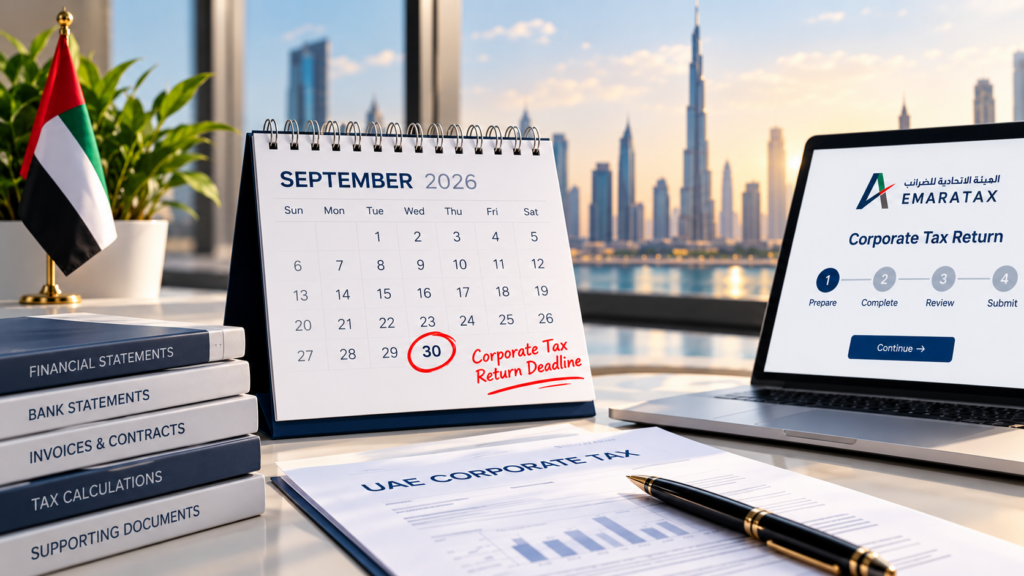
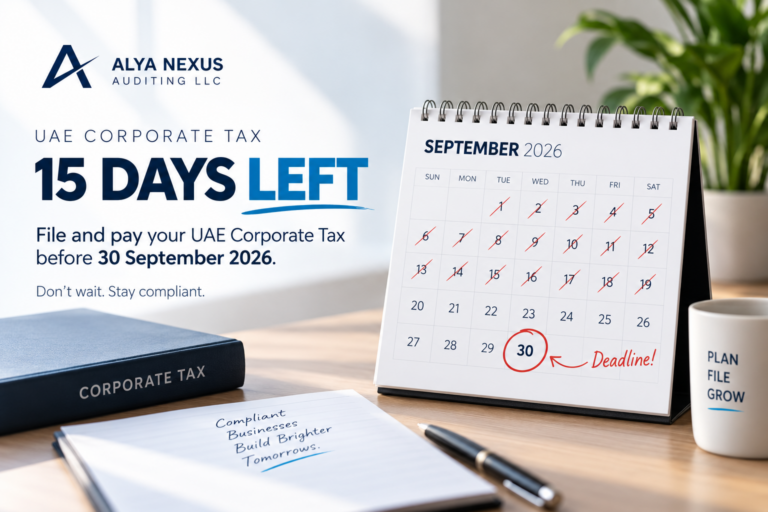
Corporate tax return filing UAE deadlines are here. If your company’s tax period ended on 31 December 2025, you must file your return and pay any tax due by 30 September 2026. The Federal Tax Authority (FTA) repeated this in a public reminder this month.
This is the second filing season under the UAE corporate tax regime, and the FTA is not treating it as a soft launch. Late filing carries a fixed monthly penalty, unpaid tax accrues interest, and the FTA does not grant routine extensions.
This guide covers who must file, the documents you need, how filing works on EmaraTax, what late filing costs, and the mistakes that trip up businesses at the last minute.
Quick Answer: Companies with a tax period ending 31 December 2025 must file their corporate tax return and pay any tax due by 30 September 2026. The deadline is nine months after the tax period ends. Filing happens on the FTA’s EmaraTax portal. Every taxable person must file, including free zone companies at 0% and businesses using Small Business Relief. Late filing costs AED 500 per month for the first 12 months, then AED 1,000 per month, plus 14% a year on unpaid tax.
Table of Contents
1. Who Must Complete Corporate Tax Return Filing in the UAE
Every taxable person registered for UAE corporate tax must file a return for each tax period. That includes mainland companies, free zone companies, and other registered entities. Profit level does not matter.
- Mainland companies file, whether profitable or loss-making
- Free zone companies file, even when they expect a 0% rate on qualifying income
- Businesses using Small Business Relief still file, under a simplified return
- Dormant companies with an active registration are still expected to file
Registration and filing are separate duties. Having a Tax Registration Number does not satisfy the filing obligation. Each tax period needs its own return.
If you registered late or are unsure your registration is correct, read our guide on UAE corporate tax registration mistakes that trigger penalties before you file.
2. The Corporate Tax Deadline UAE 2026: What Date Applies to You
The rule is simple. The return and payment are both due within nine months of the end of your tax period.
- Tax period ending 31 December 2025: file and pay by 30 September 2026
- Tax period ending 30 June 2026: file and pay by 31 March 2027
- Other year-ends follow the same nine-month count from the period end date
Do not assume 30 September applies to you. Check the tax period registered on your EmaraTax account. Companies that changed their financial year, or that follow a parent company’s reporting calendar, often have a different deadline.
You can view your registered tax period and filing status on the FTA’s EmaraTax portal.
3. Filing and Payment Are Two Separate Obligations
This is the most common source of penalties. Filing the return does not pay the tax. Paying the tax does not file the return. Both are due by the same date, and the FTA tracks them separately.
- File on time but pay late: a late payment penalty applies
- Pay on time but file late: a late filing penalty applies
- Start bank transfers several days early, because funds must clear by the deadline
Keep two pieces of proof: the filing confirmation from EmaraTax, and the payment confirmation from your bank.
4. Documents You Need Before You File
Gather these before you open EmaraTax. Missing documents are the main reason filings stall in the final week.
Company and Registration Documents
- Corporate tax registration details and Tax Registration Number
- Valid trade licence
- Memorandum of Association and details of owners and shareholders
Financial Records
- Financial statements for the full tax period
- Trial balance and general ledger
- Bank statements, reconciled to your accounting records
- Sales and purchase invoices and supporting contracts
- Fixed asset register and depreciation schedules
Tax-Specific Support
- A calculation of accounting profit adjusted to taxable income
- Records of related-party and connected-person transactions, with pricing support
- Evidence supporting any exemption, relief, or qualifying income claim
- Prior VAT returns, which should reconcile to the revenue in your corporate tax return
The law requires you to keep supporting records for at least seven years. Store them somewhere your team can retrieve quickly.
5. Do You Need Audited Financial Statements to File?
Not every company needs an audit to file. But several groups do, and they often find out late.
- Qualifying Free Zone Persons need audited financial statements to keep the 0% rate
- Companies with revenue above AED 50 million need audited financial statements
- Many mainland LLCs also need an audit for licence renewal, which feeds into the same accounts
Businesses with revenue above AED 3 million generally need to prepare financial statements on an accrual basis under IFRS. Confirm the current thresholds against the latest FTA and Ministry of Finance decisions.
If you need an audit and have not started, act now. Choose an auditor carefully. Our guide on choosing an accredited auditor in Dubai explains how to verify accreditation, including free zone approval.
6. How Corporate Tax Filing UAE Works on EmaraTax: Step by Step
- Log in to EmaraTax and open your corporate tax account
- Select the tax period you are filing for
- Enter accounting income and the adjustments that lead to taxable income
- Complete the declarations for exemptions, reliefs, and related-party transactions
- Upload supporting documents where the form requires them
- Review the calculated tax liability, then submit and save the confirmation
- Pay the tax due using the payment reference EmaraTax generates
If a Tax Agent files for you, ask for the submission confirmation directly. Do not assume the return went through.
Registration and filing guidance is published on the FTA corporate tax page.
7. Special Cases: Free Zone, Small Business Relief, and Tax Groups
Free Zone Companies
A free zone company can access a 0% rate only on qualifying income, and only while it meets every Qualifying Free Zone Person condition. It still files a return. Income that does not qualify is taxed at 9%.
Small Business Relief
Eligible small businesses can treat their taxable income as nil. They still file a return and make the relevant election. Relief changes the tax calculation. It does not remove the filing duty. The relief is time-limited, so check its current availability for your tax period.
Tax Groups
A tax group files one consolidated return through its parent company. Confirm which entity files and that every member’s records feed into the group return.
8. What Late Filing Costs
- Late filing: AED 500 per month for the first 12 months, then AED 1,000 per month
- Late payment: 14% a year on the unpaid tax, calculated monthly
- Late registration: a fixed AED 10,000 penalty, covered in our registration guide
The FTA does not offer routine extensions. Filing late does not reduce what you owe. It only adds cost.
Penalties can also stack with VAT exposure. See our VAT penalties guide for 2026 for the wider picture.
9. Common Corporate Tax Filing Mistakes
Treating 0% or Small Business Relief as No Filing
Neither removes the filing duty. Businesses that assume otherwise miss the deadline and pay penalties on a return that would have shown no tax due.
Filing Without Paying, or Paying Without Filing
Both trigger penalties. Complete both by 30 September.
Leaving Payment to the Last Day
Bank transfers can take days to clear. A payment sent on 30 September may land in October. Send funds early.
Unreconciled VAT and Corporate Tax Figures
The FTA can compare your VAT returns with your corporate tax revenue. A gap without an explanation invites questions. Reconcile the two before you file.
Our guide on FTA audit triggers in the UAE explains why this mismatch matters.
Discovering the Audit Requirement Too Late
An audit cannot be finished in a few days. Confirm whether you need one as soon as your books close.
Weak Support for Deductions and Related-Party Pricing
Claims without documents are hard to defend. Keep contracts, invoices, and pricing support with the return file.
Assuming a Tax Agent Has Filed
Always ask for the EmaraTax confirmation. A missing confirmation on 1 October is too late.
10. A Worked Example: What Three Months of Delay Costs
Take a company with AED 100,000 of corporate tax due for the 2025 tax period. It misses 30 September and files and pays three months late.
- Late filing penalty: 3 months at AED 500 = AED 1,500
- Late payment penalty: AED 100,000 at 14% a year for 3 months = AED 3,500
- Total added cost: AED 5,000, on top of the AED 100,000 tax
This is a simple illustration. The FTA applies its own rules on part months, so treat the figures as a guide. The point stands: the delay produced AED 5,000 of avoidable cost.
11. Final Filing Checklist
- Confirm your tax period and exact deadline on EmaraTax
- Close your books and reconcile bank accounts
- Confirm whether you need audited financial statements
- Calculate taxable income and have a second person review it
- Reconcile VAT returns to corporate tax revenue
- Gather supporting documents for every claim
- File on EmaraTax and save the confirmation
- Send payment early and keep proof of payment
For a day-by-day version, use our corporate tax filing checklist for the last two weeks.
12. Working With a Corporate Tax Consultant in Dubai
A corporate tax consultant in Dubai can prepare the return, review your calculation, coordinate the audit, and confirm the submission. The value is highest when your books are messy, your structure is complex, or you are near the deadline.
Alya Auditors provides accounting services, audit and assurance, and free zone audit support under one roof, so your records, audit, and tax return stay consistent.
Image Suggestions (For Publishing)
- Featured image: calendar with 30 September highlighted beside a tax return form. Alt text: “corporate tax return filing UAE 2026 deadline”
- Section 4: documents checklist graphic. Alt text: “documents needed for corporate tax return filing UAE”
- Section 10: penalty cost breakdown graphic. Alt text: “corporate tax return filing UAE late penalty example”
Use descriptive file names such as corporate-tax-return-filing-uae-documents.jpg.
Internal Linking Suggestions (For Publishing)
- UAE Corporate Tax Registration Mistakes That Trigger Penalties (Section 1)
- Accredited Auditors in Dubai: How to Choose the Right Firm (Section 5)
- VAT Penalties UAE: A Complete 2026 Guide (Section 8)
- FTA Audit Triggers UAE (Section 9)
- Corporate Tax Filing Checklist: Your Last 2 Weeks (Section 11)
- Accounting Services, Audit and Assurance, and Audit in Free Zones service pages (Section 12)
- Link back to this article from the checklist post, and from the free zone vs mainland post
Frequently Asked Questions
What is the corporate tax return filing deadline in the UAE for 2026?
For a tax period ending 31 December 2025, the return and any tax due are both due by 30 September 2026. The deadline is nine months after the tax period ends.
Do free zone companies have to file a corporate tax return?
Yes. Free zone companies file even when they expect a 0% rate on qualifying income. Non-qualifying income is taxed at 9%.
Do Small Business Relief companies need to file?
Yes. They file a simplified return and make the relevant election. Relief affects the tax calculation, not the filing duty.
Can I get an extension on the corporate tax deadline?
The FTA does not grant routine extensions. Plan to file and pay within the nine-month window.
What is the penalty for late corporate tax filing?
AED 500 per month for the first 12 months, then AED 1,000 per month. Unpaid tax also accrues 14% a year.
Do I need audited financial statements to file?
Qualifying Free Zone Persons and companies with revenue above AED 50 million do. Many other businesses need an audit for licence renewal. Confirm your position early.
How do I file the corporate tax return?
File through the FTA’s EmaraTax portal, or through a Tax Agent. Save the submission confirmation and pay using the generated payment reference.
How long should I keep corporate tax records?
At least seven years. Keep invoices, contracts, ledgers, and calculation workings together.
Can Alya Auditors help with corporate tax return filing?
Yes. Alya Auditors reviews your records, coordinates any required audit, and prepares your return. Contact Alya Auditors to review your position.
Conclusion
Corporate tax return filing in the UAE comes down to four things: know your deadline, prepare the right documents, file and pay as two separate steps, and leave time for bank transfers to clear.
Most penalties this season will come from avoidable causes. Businesses assume 0% means no filing. They discover an audit requirement late. They pay on the final day. None of these needs a specialist to fix, only earlier action.
If your books, audit, or calculation are not ready, start with the biggest gap today.
Get a Corporate Tax Compliance Review
Not sure whether your company is ready for Corporate Tax filing? Get a Corporate Tax compliance review from Alya Auditors. Visit alyaauditors.com or call +971 52 975 0690.


Ready to Start?
Talk to a UAE compliance expert
Book a free, no-obligation consultation with ALYA Nexus Auditing.
Book Free Consultation ↗