
What Happens If You Miss a UAE Free Zone Audit Deadline
 July 3, 2026
11 min read
July 3, 2026
11 min read
What Happens If You Miss Your Free Zone Audit Deadline?
Running a business inside a UAE free zone comes with real advantages — 100% foreign ownership, streamlined licensing, and access to some of the region’s best infrastructure. But those advantages come with a condition most owners underestimate: the annual audit deadline. Miss it, and the fallout is rarely just a warning letter.
If you’re a business owner, startup founder, or finance decision-maker in Dubai, Abu Dhabi, Sharjah, or any other emirate, this guide breaks down exactly what happens when a free zone audit deadline slips — and what you can do about it, whether you’re at risk of missing one or already have.
Quick Answer
Missing a UAE free zone audit deadline typically triggers an administrative fine, a hold on your trade license renewal, and suspension of e-services such as visa processing. Because your Corporate Tax return depends on audited financial statements, a late audit also delays your Federal Tax Authority filing, adding a second layer of penalties on top of the free zone’s own enforcement action.
Table of Contents
- What Is a Free Zone Audit Deadline?
- Why UAE Free Zones Require Annual Audits
- Common Free Zone Audit Deadline Structures
- Immediate Consequences of Missing the Deadline
- How a Late Audit Affects Your Corporate Tax Filing
- Free Zone–Specific Enforcement: JAFZA, DMCC, RAKEZ and Others
- Long-Term Business Risks Beyond the Fine
- What to Do If You’ve Already Missed the Deadline
- How to Avoid Missing Future Audit Deadlines
- Why UAE Businesses Choose Alya Auditors
- FAQ
- Conclusion
What Is a Free Zone Audit Deadline?
A free zone audit deadline is the date by which a company registered in a UAE free zone must submit its audited financial statements to the relevant free zone authority. The audit must be prepared by a licensed auditor, follow International Financial Reporting Standards (IFRS), and, in many zones, be carried out by a firm from the authority’s approved auditor list.
This deadline is separate from — but closely linked to — your Corporate Tax filing deadline with the Federal Tax Authority (FTA). Understanding both timelines together is the only way to stay fully compliant.
In short:
- It applies to almost every active free zone entity, not just large companies
- It is set by the free zone authority, not the FTA
- It is usually tied to your license renewal cycle
- Missing it triggers penalties that are separate from — and additional to — any tax penalties
Why UAE Free Zones Require Annual Audits
Free zone authorities require audited accounts for a simple reason: transparency. Audited financial statements confirm that a company is genuinely operating, keeping proper records, and reporting income accurately — which supports the UAE’s broader push toward economic substance and regulatory credibility.
Since the introduction of UAE Corporate Tax, audits have taken on an even bigger role. Free zone companies that want to keep their 0% tax rate as a Qualifying Free Zone Person (QFZP) must maintain audited financial statements prepared under IFRS, regardless of their income level. Our free zone audit requirements guide covers this in more depth if you want the full picture of what qualifies.
Banks, investors, and government bodies also increasingly ask for audited accounts before extending credit, renewing facilities, or approving expansion — so the audit isn’t just a compliance box to tick. It’s a trust document.
Common Free Zone Audit Deadline Structures
Not every free zone works on the same timeline. Broadly, deadlines fall into three patterns:
- 90 days after financial year-end — used by zones such as JAFZA and Hamriyah Free Zone
- 120 to 180 days after financial year-end — a common window, with 180 days being one of the most widely used submission periods among larger zones
- Tied to license renewal — some authorities don’t set a fixed calendar date but instead require the audit before your annual license can be renewed
Because there is no single UAE-wide rule, the safest approach is to check your specific free zone’s portal notice or confirm the applicable window with your auditor early in the financial year — not close to the deadline. For a full breakdown by authority, see our audit checklist for UAE deadlines and free zone requirements.
Immediate Consequences of Missing the Deadline
Once a deadline passes, most free zone authorities don’t offer a grace period. Here’s what typically follows:
1. Administrative Fines
Late submission usually triggers a financial penalty that grows the longer the audit remains outstanding. Fines are commonly charged per month of delay, and in several zones can reach into five figures if the delay continues.
2. Blocked License Renewal
This is often the consequence business owners feel first. Your trade license renewal is placed on hold until the outstanding audit is submitted and accepted — meaning you cannot legally continue operating on an expired license.
3. Suspended E-Services
Many free zones freeze access to their online portals once a company falls out of compliance. This affects your ability to issue or renew employee visas, process amendments, or request new certificates.
4. Visa Quota and Immigration Impact
Because license status and visa quotas are linked, a blocked renewal can stop you from sponsoring new staff or renewing existing employee and dependent visas — a serious operational problem for growing teams.
5. Rejected Submissions from Unapproved Auditors
Several major zones, including DMCC, DIFC, DAFZA, and JAFZA, only accept audits from firms on their approved auditor list. An audit submitted by a non-approved firm is rejected outright, not merely delayed — meaning the engagement has to restart with a listed firm, costing you more time.
How a Late Audit Affects Your Corporate Tax Filing
This is the part many business owners miss until it’s too late. Your UAE Corporate Tax return cannot be filed without finalized, audited financial statements behind it. If your free zone audit is delayed, your Corporate Tax return is delayed too — and the FTA’s own penalty clock starts independently of your free zone’s enforcement action.
That means a single missed audit deadline can expose your business to two separate sets of penalties at the same time: one from your free zone authority, and one from the FTA for late or inaccurate Corporate Tax filing. If you’re still working through your Corporate Tax obligations, our UAE Corporate Tax guide walks through registration, filing, and compliance strategy in detail. You can also review the FTA’s own guidance directly at the Federal Tax Authority website.
For companies relying on QFZP status to keep the 0% Corporate Tax rate, a missing or late audit can jeopardize that status entirely, potentially exposing previously tax-free profit to the standard rate.
Free Zone–Specific Enforcement
While the general pattern is similar across the UAE, enforcement details differ by authority:
- JAFZA — Deadlines typically fall around 90 days after year-end. Late submissions attract a fine and a hold on license renewal until the outstanding audit is resolved. Only auditors on JAFZA’s approved list can perform the engagement.
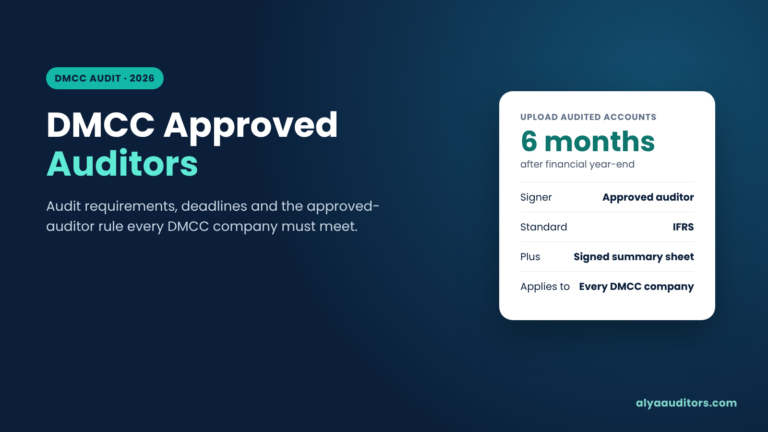
- DMCC — Audited financial statements are generally due within 180 days of the fiscal year-end. DMCC also maintains a closed list of approved auditors, and dormant companies must formally apply for an exemption rather than assume one applies automatically.
- RAKEZ — Offers a somewhat longer window than JAFZA but has tightened enforcement in recent years, including for smaller entities that may previously have received more flexibility.
- IFZA, Meydan, SHAMS, and similar zones — Many accept audits from any UAE-licensed audit firm rather than maintaining a closed approved list, but the audit must still be IFRS-compliant to support Corporate Tax filing.
Because rules genuinely differ by zone, it’s worth confirming your company’s exact deadline and approved-auditor requirements rather than assuming the rule that applies to a colleague’s business in a different free zone applies to yours. Alya Auditors holds approved-auditor status across multiple UAE free zones — you can check our current listings, including DMCC & JLT approved auditors and JAFZA approved auditors.
Long-Term Business Risks Beyond the Fine
The immediate fine is rarely the most expensive part of missing a deadline. The longer-term risks include:
- Banking relationships — Banks increasingly request audited financials before renewing credit facilities or opening new accounts; a compliance gap can complicate both.
- Investor and partner confidence — Investors evaluating a UAE entity will almost always ask for audit history. A pattern of late filings raises governance concerns.
- Compounding penalties — Fines that accrue monthly can escalate quickly if left unresolved, turning a manageable issue into a significant liability.
- Loss of QFZP tax benefits — As noted above, this can mean paying standard Corporate Tax rates on profit that would otherwise qualify for 0%.
- Reputational impact during license renewal reviews — Free zone authorities review compliance history at renewal, and a poor record can affect future dealings with the authority.
What to Do If You’ve Already Missed the Deadline
If your deadline has already passed, the priority is damage control, not panic. A practical remediation path looks like this:
- Confirm the exact status with your free zone authority — how much is owed, and what documentation is outstanding.
- Engage an approved auditor immediately to begin the audit, prioritizing the zones with closed auditor lists first.
- Prepare or update your bookkeeping so the audit isn’t delayed further by incomplete records — our bookkeeping services can fast-track this step.
- Coordinate the Corporate Tax filing timeline alongside the audit so both processes close out together rather than creating a second penalty later.
- Request license reinstatement once the audit is accepted, and clear any outstanding e-services suspension.
This is exactly the kind of situation where a firm with strong authority relationships and free zone experience makes a measurable difference in turnaround time. Alya Auditors has handled remediation cases like this across JAFZA, DMCC, RAKEZ, and other zones — you can book a consultation to get a clear recovery plan for your specific situation.
How to Avoid Missing Future Audit Deadlines
Prevention is far cheaper than remediation. Consider this a working checklist:
- Mark your audit deadline the same day you confirm your financial year-end — don’t wait for a renewal notice
- Keep bookkeeping current throughout the year rather than reconstructing records at deadline time
- Confirm whether your free zone maintains an approved auditor list, and engage that firm early
- Align your audit timeline with your Corporate Tax filing calendar so both are handled together
- Maintain a bank confirmation and trial balance ready ahead of the audit start date
- Work with a firm that tracks multi-jurisdiction deadlines if you operate across more than one free zone
If you’d like a structured starting point, our audit checklist for UAE deadlines and free zone compliance lays out the required documents zone by zone.
Why UAE Businesses Choose Alya Auditors
Alya Auditors has supported over 3,000 businesses across Dubai, Sharjah, and the wider UAE with more than 4,500 completed audits and 17+ years of UAE compliance experience. We are approved auditors across major free zones including DMCC, DIFC, JAFZA, DAFZA, IFZA, and Meydan, and we apply Six Sigma-based quality processes alongside an AI-powered audit tracking system so clients always know exactly where their engagement stands.
For businesses facing a tight or missed deadline, our team focuses on fast, accurate turnaround without cutting corners on compliance — because a rushed audit that gets rejected by the authority only adds more delay. Explore our full audit in free zones services or view approved auditor listings by free zone to find your jurisdiction.
FAQ
What happens if I miss my free zone audit deadline in the UAE? You’ll typically face an administrative fine, a hold on your trade license renewal, and suspended e-services until the audit is submitted and accepted by your free zone authority.
Can my Corporate Tax return be filed without an audit? No. Your Corporate Tax return is built on audited financial statements. If the audit is delayed, your Corporate Tax filing is delayed too, which can trigger separate FTA penalties.
Do all UAE free zones follow the same audit deadline? No. Deadlines vary by authority — commonly 90 days, 120 to 180 days after year-end, or tied directly to license renewal. Always confirm the specific rule with your free zone.
Can I use any auditor for my free zone audit? Not always. Zones such as DMCC, DIFC, DAFZA, and JAFZA require auditors from their approved list. Using a non-approved firm results in the submission being rejected.
Will a late audit affect my company’s visa quota? It can. License renewal holds and e-services suspensions are often linked to visa processing, which can prevent new visa issuance or renewals until the audit is cleared.
What should I do first if I’ve already missed the deadline? Confirm your exact compliance status with the free zone authority, then engage an approved auditor immediately to begin remediation before penalties compound further.
Does missing the deadline affect my 0% Corporate Tax rate as a Qualifying Free Zone Person? It can. QFZP status generally requires audited financial statements prepared under IFRS. A missing or late audit can put that 0% rate at risk.
Conclusion
A missed free zone audit deadline is rarely just a paperwork problem. It cascades into license risk, visa disruption, and Corporate Tax penalties that compound the longer they go unresolved. The good news is that every stage of this — from prevention to full remediation — is manageable with the right support and a clear timeline.
Whether your deadline is approaching or has already passed, the fastest path back to full compliance is working with a firm that knows your free zone’s exact requirements.
Ready to protect your license and avoid compounding penalties? Book a free consultation with Alya Auditors today, and let our approved auditors get your free zone audit — and your Corporate Tax filing — back on track.

Keep reading

Ready to Start?
Talk to a UAE compliance expert
Book a free, no-obligation consultation with ALYA Nexus Auditing.
Book Free Consultation ↗