

QFZP Compliance Updates: FTA Decision No. 6 of 2026 Explained
The QFZP AUP report is the newest, and for some free zone businesses the most consequential, compliance requirement to land on the UAE corporate tax landscape in 2026. Issued by the Federal Tax Authority on 2 June 2026, FTA Decision No. 6 of 2026 introduces a mandatory independent verification report for a specific category of free zone businesses — and getting it wrong risks the 0% tax rate entirely.
This isn’t a distant planning item. The Decision applies to tax periods starting on or after 1 January 2026, which means calendar-year businesses already fall within its scope right now, months before most affected companies have even heard of it, let alone started preparing for it.
This guide explains exactly what the QFZP AUP report requires, who it applies to, the deadline mechanics, and what happens if a business misses it.
Quick Answer: The QFZP AUP report is a new annual requirement under FTA Decision No. 6 of 2026 for Qualifying Free Zone Persons whose qualifying activity is distributing goods or materials in or from a Designated Zone. An independent, UAE-licensed auditor must verify customer reseller status and Designated Zone importation under ISRS 4400 standards, and the report is due within 30 days of the corporate tax return deadline. Missing it risks losing QFZP status, and the 0% rate, for that activity.
Table of Contents
1. What Is the QFZP AUP Report?
An Agreed-Upon Procedures (AUP) report is a specific type of engagement where an independent auditor performs a set of predefined procedures and reports factual findings — not an audit opinion, and not confirmation of QFZP status itself. Under FTA Decision No. 6 of 2026, this report becomes a mandatory annual deliverable for a specific group of Qualifying Free Zone Persons.
- It’s prepared under ISRS 4400 (International Standard on Related Services), the international standard governing agreed-upon procedures engagements
- It’s separate from, and additional to, the annual audited financial statements every QFZP must already prepare
- It tests two specific things: customer reseller status, and importation of goods through a Designated Zone
- It must be prepared by an independent auditor licensed to practise in the UAE
The report doesn’t change who qualifies for the 0% rate. It changes how that qualification must be proven — shifting the burden from a business’s own assertion to independently verified evidence.
A business that qualifies as a Qualifying Free Zone Person can benefit from the 0% corporate tax rate on qualifying income, while non-qualifying income remains subject to the standard 9% rate. For distribution-based QFZPs specifically, this new AUP report becomes part of what keeping that status actually requires.
2. Why the FTA Introduced This Requirement
For distribution-based Qualifying Free Zone Persons, the 0% corporate tax rate has always depended on genuinely meeting specific conditions — particularly that customers are buying goods for resale, and that goods genuinely move through a Designated Zone. Until now, businesses largely self-certified this.
FTA Decision No. 6 of 2026 closes that gap. By requiring independent, standardised verification, the FTA can be more confident that only businesses genuinely meeting the qualifying conditions continue to benefit from preferential tax treatment — and can identify, more systematically, businesses that don’t.
This fits a broader pattern in UAE tax enforcement through 2026: shifting compliance verification away from self-declaration and toward independently verified evidence, wherever the tax benefit at stake is significant enough to justify the added scrutiny.
3. Who Actually Needs a QFZP AUP Report
This requirement is narrowly scoped. It does not apply to every Qualifying Free Zone Person — only to those whose qualifying activity is the distribution of goods or materials in or from a Designated Zone, as defined under Ministerial Decision No. 229 of 2025.
- Free zone trading and wholesale distribution businesses
- Logistics and supply chain operators moving goods through a Designated Zone
- Warehousing operations tied to qualifying distribution activity
If your free zone business earns qualifying income from a different qualifying activity — manufacturing, holding investments, headquarters services — this specific AUP requirement doesn’t apply to you, though your existing audited financial statement obligation under Ministerial Decision No. 84 of 2025 still does.
4. What the AUP Report Actually Verifies
Verifying Reseller Status
The report must demonstrate that customers acquiring goods from the QFZP are genuinely purchasing them for resale, onward supply, or processing ahead of resale. Supporting documentation includes valid business, trade, or commercial licences confirming the customer’s resale activity.
Verifying Designated Zone Importation
Where the QFZP imports goods entering the UAE, it must maintain a traceable import record — import declarations, permits, customs clearance documents, and transport records such as bills of lading and airway bills.
Both strands require documentation collected at the time of the transaction, not reconstructed months later when the audit deadline approaches.
5. Who Can Prepare the Report
The AUP report can be prepared by the same independent auditor responsible for the QFZP’s annual financial statement audit, or by a different independent auditor licensed to practise in the UAE. Either way, the auditor must follow ISRS 4400 procedures and report factual findings rather than an opinion.
Businesses should confirm their chosen auditor holds a current licence through the standard channels — the same verification process covered in our guide on choosing an accredited auditor in Dubai applies equally here.
6. The Deadline: 30 Days After Your Corporate Tax Return Deadline
The AUP report is due no later than 30 days after the statutory corporate tax return deadline for the relevant tax period — calculated from the legal filing deadline, not from whenever a business happens to file early.
For a calendar-year tax period ending 31 December 2026, the corporate tax return would ordinarily be due 30 September 2027, putting the AUP report due around 30 October 2027 — unless the FTA specifies another date. Registration and filing itself continues through the FTA’s EmaraTax portal.
Thirty days is a tight window to start an AUP engagement from scratch. Businesses need to reconcile their customer and import populations, collect supporting documentation, and engage their auditor well ahead of the deadline — not after it.
7. What Happens If You Miss the Deadline
- Failure to submit the AUP report means the relevant conditions under Ministerial Decision No. 84 of 2025 and Ministerial Decision No. 229 of 2025 are treated as unmet
- The business loses Qualifying Free Zone Person status for that qualifying activity for the relevant period
- Income that would have qualified for the 0% rate becomes subject to standard 9% corporate tax instead
This sits within the UAE’s broader QFZP framework, where failing any qualifying condition generally disqualifies a business from QFZP status for the current year and several following years, with the option to retest eligibility later. The exact consequence for this specific decision should be confirmed against the current text of the Decision and Ministerial Decisions 84 and 229 of 2025, but the direction is consistent: this is not a routine late-filing fee — it’s a condition of the tax benefit itself.
8. How This Differs From the Annual Audited Financial Statements
Every QFZP already needs annual audited financial statements under Ministerial Decision No. 84 of 2025. The AUP report is a separate, additional deliverable — narrower in scope, focused specifically on the distribution qualifying activity, and reported as factual findings rather than a financial statement opinion.
Current corporate tax registration and filing guidance, including for QFZPs, is maintained on the FTA’s corporate tax registration page.
A business can have a clean audit opinion on its financial statements and still fail to meet the AUP requirement if the underlying reseller and importation documentation isn’t in order. The two engagements test different things.
9. Practical Steps to Prepare Now
- Confirm whether your qualifying activity actually falls under Designated Zone distribution as defined in Ministerial Decision No. 229 of 2025
- Start collecting customer trade licences and resale documentation as transactions happen, not retrospectively
- Maintain complete import records — declarations, permits, customs clearance, and transport documents — in an organised, accessible system
- Engage your auditor early, well before the 30-day post-filing window opens
- Coordinate across tax, finance, logistics, and customs teams, since the evidence spans more than just the finance function
- Review your ERP and document retention processes to ensure evidence is captured contemporaneously
10. A Worked Example
Picture a Designated Zone trading company with a calendar-year tax period. Its corporate tax return for the 2026 tax period will be due around 30 September 2027, which means its QFZP AUP report is due roughly 30 October 2027 — over a year away, but the evidence that report will rely on is being created, or lost, right now, in every transaction happening through 2026.
A company that starts collecting customer resale documentation and import records from January 2026 onward will have a straightforward AUP engagement in late 2027. A company that waits until the filing deadline approaches will be reconstructing a year and a half of transaction history under serious time pressure — with the 0% rate on the line if the reconstruction doesn’t hold up.
11. Why Partner With Alya Auditors
Alya Auditors provides audit and assurance services and free zone-approved audits across the UAE, including the kind of independent verification work this new AUP requirement calls for. Getting ahead of the documentation now protects the 0% rate later.
Frequently Asked Questions
What is FTA Decision No. 6 of 2026?
It’s a decision issued by the Federal Tax Authority on 2 June 2026, requiring Qualifying Free Zone Persons engaged in distributing goods or materials in or from a Designated Zone to obtain an independent Agreed-Upon Procedures report verifying their compliance with that qualifying activity’s conditions.
Which businesses need a QFZP AUP report?
Only Qualifying Free Zone Persons whose qualifying activity is the distribution of goods or materials in or from a Designated Zone. Other QFZP activities are not affected by this specific requirement.
When is the QFZP AUP report due?
Within 30 days of the statutory corporate tax return filing deadline for the relevant tax period, calculated from the legal deadline rather than an early filing date.
What happens if a business misses the AUP report deadline?
The relevant qualifying conditions are treated as unmet, meaning the business loses Qualifying Free Zone Person status for that activity, and the associated income becomes subject to the standard 9% corporate tax rate instead of 0%.
Is the AUP report the same as the annual audited financial statements?
No. They’re separate, additional requirements. The annual audit applies to all QFZPs generally; the AUP report is narrower and specific to distribution activity in a Designated Zone.
Does this apply retroactively to earlier tax periods?
No. The Decision applies to tax periods commencing on or after 1 January 2026, though it was issued mid-year on 2 June 2026 — meaning calendar-year businesses are already within scope for their current tax period.
What documentation should businesses start collecting immediately?
Customer trade licences confirming resale activity, and import records such as declarations, permits, customs clearance documents, and transport paperwork like bills of lading — collected as transactions happen, not reconstructed later.
Can Alya Auditors prepare a QFZP AUP report?
Yes. Alya Auditors provides independent audit and assurance services relevant to QFZP compliance across UAE free zones. Get in touch with Alya Auditors to discuss your specific qualifying activity and documentation readiness.
Conclusion
FTA Decision No. 6 of 2026 doesn’t change who qualifies for the 0% corporate tax rate on distribution activity — it changes how that qualification has to be proven, and hands that proof obligation to an independent auditor working to an international standard.
For affected free zone distributors, the evidence this report will eventually test is being created, or lost, in transactions happening right now. Businesses that start documenting reseller status and import records early will find the eventual AUP engagement straightforward. Businesses that wait will be reconstructing evidence under pressure, with the 0% rate itself on the line.
This is a narrow requirement, affecting a specific slice of free zone businesses — but for those it applies to, the stakes are as high as any compliance decision they’ll make this year.
If your free zone business distributes goods through a Designated Zone, this is worth acting on now — not when the filing deadline forces the issue.
Talk to Alya Auditors
Alya Auditors helps UAE free zone businesses prepare for the QFZP AUP report and stay ahead of evolving corporate tax compliance requirements. Visit alyaauditors.com or call +971 52 975 0690 to review your QFZP compliance position.

Keep reading
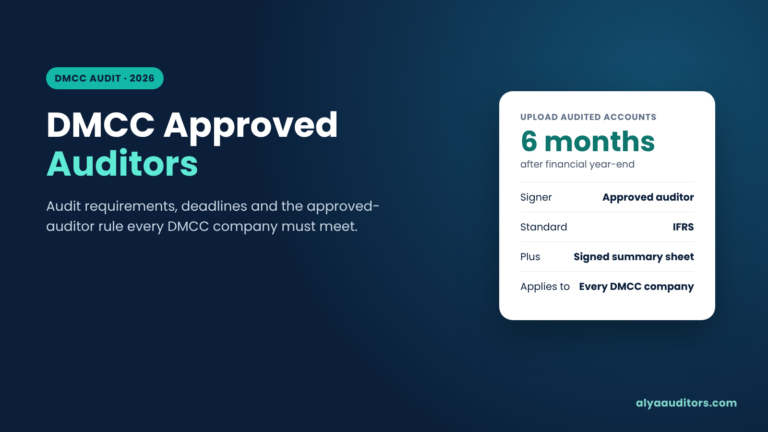 Audit & Assurance Services DMCC Approved Auditors: 2026 Audit Requirements Guide
October 12, 2026
Audit & Assurance Services DMCC Approved Auditors: 2026 Audit Requirements Guide
October 12, 2026
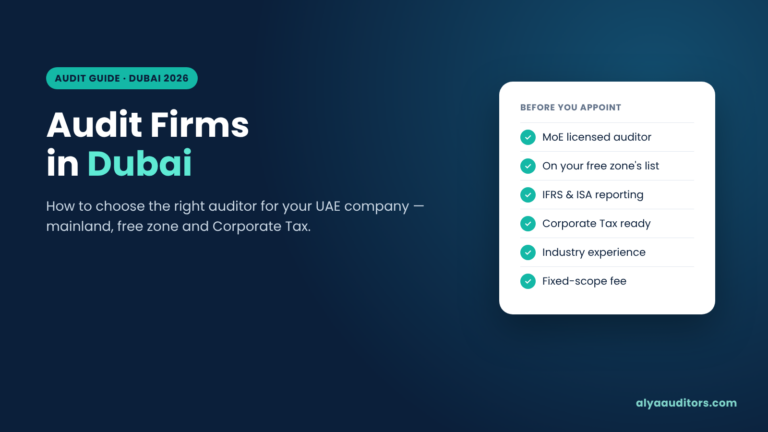 Audit & Assurance Services Audit Firms in Dubai: How to Choose the Right Auditor
October 9, 2026
Audit & Assurance Services Audit Firms in Dubai: How to Choose the Right Auditor
October 9, 2026
 Audit & Assurance Services Corporate Tax Registration UAE: Who Needs to Register and What Happens If You Delay?
October 5, 2026
Audit & Assurance Services Corporate Tax Registration UAE: Who Needs to Register and What Happens If You Delay?
October 5, 2026
Ready to Start?
Talk to a UAE compliance expert
Book a free, no-obligation consultation with ALYA Nexus Auditing.
Book Free Consultation ↗