

How to Choose an Audit Firm in Dubai:
The Complete 2026 Guide for UAE Businesses
Knowing how to choose an audit firm in Dubai is one of the most important financial decisions a UAE business owner will make. Whether you are a startup navigating your first statutory audit, an SME scaling across emirates, or an investor managing multiple entities, the auditor you choose directly affects your compliance standing, your financial credibility, and your long-term growth.
Dubai alone has hundreds of registered audit firms — from boutique single-partner offices to the Big Four. The challenge is not finding one. The challenge is finding the right one for your specific business, jurisdiction, and growth stage.
This guide gives you a clear, step-by-step framework to evaluate, shortlist, and confidently choose an audit firm in Dubai or anywhere across the UAE.
| Quick Answer To choose an audit firm in Dubai, verify the firm is registered with the Ministry of Economy or your free zone authority. Evaluate their industry experience, team qualifications, service scope, and client references. Confirm they understand UAE Corporate Tax law, IFRS reporting standards, and VAT compliance requirements specific to your business jurisdiction. |
1. Why the Right Audit Firm Matters More Than You Think
An audit is not just a box to tick at the end of your financial year. In the UAE, a statutory audit serves as the financial backbone of your business. It validates your accounts for banks, investors, free zone authorities, and government regulators.
A weak or non-compliant audit report can trigger penalties, delay loan approvals, or invite scrutiny from the Federal Tax Authority (FTA). The consequences are real and often expensive.
More importantly, the quality of your auditor signals credibility to the market. Investors in Dubai and Abu Dhabi routinely make funding decisions based on who signed off on your financials. Lenders in Sharjah and across the GCC use audited statements as a primary risk assessment tool. Choosing the right audit firm is not just a compliance decision — it is a strategic business decision.
| Expert Insight “In our experience working with SMEs across Dubai, Sharjah, and Abu Dhabi, businesses that engage a registered, specialised auditor from day one are significantly better positioned for investor due diligence and regulatory review. The audit firm you choose reflects the financial governance of your entire organisation.” — Alya Auditors, Senior Audit Partner |
2. Understanding UAE Audit Regulations
Before selecting a firm, you need to understand who governs audit services in the UAE and what rules apply to your specific business.
Who Regulates Audit Firms in the UAE?
Audit firms operating in the UAE are licensed under one of several authorities, depending on where your company is registered:
- Ministry of Economy (MoE): Governs mainland audit firms across all emirates including Dubai, Abu Dhabi, Sharjah, and Ajman.
- Free Zone Authorities: Each free zone maintains its own approved auditor list. DMCC, DIFC, ADGM, JAFZA, and other free zones each have separate registries. You must use a firm specifically approved for your zone.
- Securities and Commodities Authority (SCA): Governs auditors engaged by publicly listed companies in the UAE.
If your business is registered in a UAE free zone, using an unregistered or unapproved firm will result in an invalid audit report — which can block your trade licence renewal entirely.
IFRS Reporting and UAE Corporate Tax
The UAE follows International Financial Reporting Standards (IFRS) for all financial reporting. Since June 2023, the introduction of UAE Corporate Tax at 9% on taxable profits above AED 375,000 has added a new layer of complexity to financial reporting and audit obligations.
Your chosen audit firm must be fully current on both IFRS accounting standards and the UAE Corporate Tax Law (Federal Decree-Law No. 47 of 2022). This is no longer optional knowledge — it is a baseline requirement for any credible audit firm serving UAE businesses today.
3. Eight Key Factors to Evaluate an Audit Firm in Dubai
Use these eight criteria as your evaluation framework when shortlisting audit firms. Each factor addresses a specific risk area in the selection process.
3.1 Registration and Licensing
This is the first thing to check and it is non-negotiable. Confirm the firm holds a valid licence from the Ministry of Economy or the relevant free zone authority for your jurisdiction. Ask for their licence number and verify it independently. For mainland firms in Dubai, you can cross-check on the Dubai Department of Economy and Tourism (DET) portal. For free zones, request a copy of their current approval certificate issued by the authority.
3.2 Industry Specialisation
Not all auditors have equal depth across all industries. A firm experienced in retail or trading may not have the technical knowledge required to audit a real estate developer, a healthcare group, or a fintech startup. Ask specifically how many clients in your sector they currently serve and what complex sector-specific transactions they have handled. Industry knowledge reduces audit risk and improves the quality of insights you receive beyond the report itself.
3.3 Team Qualifications
The partner signing your audit report must hold a recognised professional qualification. Look for ACCA (Association of Chartered Certified Accountants), CA (Chartered Accountant), CPA (Certified Public Accountant), or CMA (Certified Management Accountant) designations. Ask specifically who will lead and manage your engagement day-to-day — not just who is named in the proposal. Some firms pitch senior partners in the first meeting but delegate all work to junior staff throughout the engagement.
3.4 Firm Size vs. Your Business Size
The Big Four — Deloitte, PwC, EY, and KPMG — are excellent firms but are priced and structured primarily for large corporates and multinationals. Most SMEs and mid-market businesses in Dubai will receive better attention, more direct partner access, and more competitive pricing from a reputable mid-tier or boutique firm. Matching firm size to business size ensures you are a priority client, not a small account that receives minimal attention during the busy season from January to April.
3.5 Range of Services
Many UAE businesses need more than just a statutory audit. Consider whether the firm can also support you with:
- VAT return filing and FTA compliance
- UAE Corporate Tax advisory and annual filing
- Internal audit and risk management
- Due diligence for mergers, acquisitions, and investor rounds
- Management accounts and bookkeeping
- Business valuation reports
- Company liquidation and deregistration reports
Consolidating services with a single trusted firm saves time, reduces cost, and ensures consistency across all your financial records throughout the year.
3.6 Turnaround Time and Availability
Free zone audit deadlines are strict and non-negotiable. DMCC companies must submit audited financial statements within 90 days of their financial year end. Missing this deadline results in penalties and blocks licence renewal. Ask upfront about the firm’s current client load and their committed delivery timeline. A firm that is heavily overcommitted from January to March each year may not reliably serve your needs if your financial year ends in December.
3.7 Technology and Data Security
Modern audit firms use cloud-based accounting and audit software. Firms still relying heavily on manual processes or offline spreadsheets introduce higher error risk and slower turnaround times. Ask whether they work with Xero, Zoho Books, QuickBooks, Tally, or SAP — and how they handle document sharing, storage, and data privacy in compliance with UAE data protection regulations.
3.8 Client References and Reputation
A reputable firm will provide two or three client references without hesitation. Follow up on those references and ask specific questions about timeliness, communication quality, and how the firm handled challenges during the engagement. Also check their Google Business reviews, LinkedIn presence, and any professional accreditations or recognition within the UAE accounting and auditing community.
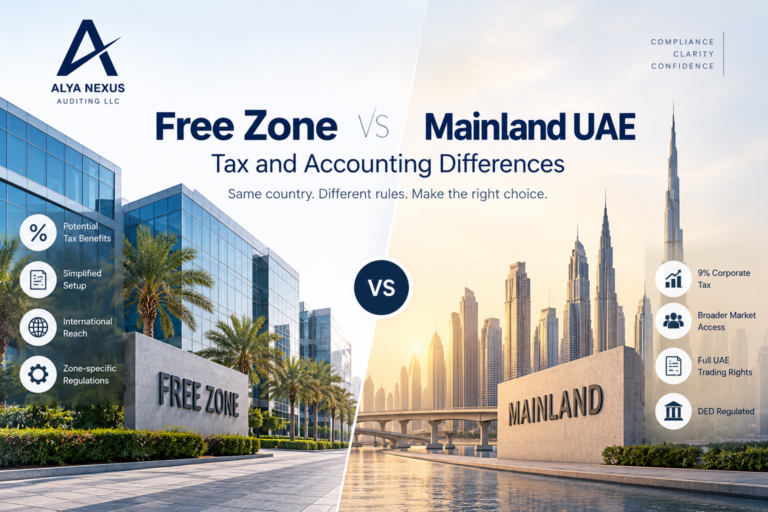
| 🖼 Body Image [ IMAGE PLACEHOLDER ] Alt text: Audit firm in Dubai comparing mainland and free zone audit requirements for UAE businesses Filename: dubai-audit-firm-mainland-vs-freezone.webp | 800 x 500 px | WebP | Under 100 KB |
4. Mainland vs Free Zone Auditors — What Is the Difference?
One of the most common mistakes UAE business owners make is assuming any licensed UAE auditor can audit any company. This is not correct, and the consequences of getting it wrong can be severe.
| Criteria | Mainland Audit Firms | Free Zone Audit Firms |
| Governing Body | Ministry of Economy | Respective Free Zone Authority |
| Client Type | Mainland LLC, branches | Free zone entities (FZCO, FZ-LLC) |
| Approved List Required? | No (general MoE licence) | Yes — zone-specific, strictly enforced |
| Corporate Tax Filing | Yes | Yes (since June 2023) |
| VAT Advisory | Yes | Yes |
| DIFC / ADGM Firms | Not eligible | Separate DIFC / ADGM authorisation required |
Key Rule: If your company is registered in DMCC, JAFZA, RAKEZ, DIFC, ADGM, or any other UAE free zone, you must use an auditor specifically approved for that zone. Check the DMCC approved auditors list or visit the free zone audit services page for more information.
5. Red Flags: When to Walk Away from an Audit Firm
Not every firm on an approved list is the right choice. These warning signs should make you pause — or walk away entirely:
- They cannot provide a valid licence number or avoid verification when asked
- They offer unrealistically low fees without a clear written scope of work
- They refuse to issue a formal engagement letter before starting work
- They cannot confirm which qualified partner will sign your audit report
- They have no digital presence, no client references, and no verifiable track record in the UAE
- They promise a clean, unqualified audit report before reviewing a single document
- They show limited or no knowledge of UAE Corporate Tax or VAT regulations introduced after 2018
- They are not on the approved auditor list for your specific free zone
Any one of these signals is a serious concern. An audit report produced by the wrong firm, or produced without genuine examination of your accounts, is a compliance risk that can carry significant financial and legal consequences — particularly under UAE Corporate Tax Law.
6. Questions to Ask Before You Sign an Engagement Letter
Prepare these ten questions for your first meeting with any potential audit firm. The quality of the answers will tell you everything you need to know.
- Are you registered with our free zone authority or the Ministry of Economy? Always verify this first with documents, not just verbal confirmation.
- Who will be the signing partner on our audit report? This person must be a licensed, qualified professional — not a manager or senior associate.
- What experience do you have in our specific industry? Look for demonstrated depth, not just a general yes.
- How many clients do you currently serve in our free zone? Familiarity with your authority reduces errors, delays, and surprises.
- What is your standard turnaround time for a full audit engagement? Factor in your free zone submission deadline before agreeing to anything.
- Will you provide a written engagement letter with scope, fees, and timeline? Non-negotiable. Never begin work without this document.
- Can you support us with UAE Corporate Tax filing and FTA representation? Essential for all UAE businesses since June 2023.
- How do you handle qualifications or material issues discovered during the audit? This tests their professional judgment and communication standards.
- What accounting software and data security practices do you follow? Protects your confidential financial data under UAE privacy regulations.
- Can you provide two or three references from clients of a similar size and industry? A reputable firm will provide these without hesitation.
7. How Much Does an Audit Cost in Dubai?
Audit fees in the UAE vary based on company size, transaction volume, complexity, and the reputation of the firm. There is no single fixed market rate, but here is a general benchmark to help calibrate your expectations:
| Business Type | Estimated Fee Range (AED) | Notes |
| Small Free Zone Entity | AED 2,500 – 5,000 | Dormant or single-shareholder company |
| Active SME / Trading Co. | AED 5,000 – 15,000 | Based on turnover and transaction volume |
| Mid-Market Business | AED 15,000 – 35,000 | Multiple subsidiaries or complex accounts |
| Large Corporate / Group | AED 35,000+ | Custom scope; Big Four price tier |
| ⚠ Important Be cautious of any firm offering a full statutory audit for AED 800 to AED 1,500. At that price point, the firm is almost certainly producing a template report without genuinely examining your books. This type of rubber-stamp audit is a serious compliance risk — especially now that the FTA can request your full audit workpapers under UAE Corporate Tax Law. |
8. Frequently Asked Questions
The following questions are formatted for Google FAQ Schema. In WordPress, use the Yoast FAQ block or WP Schema Pro to mark these up for rich results.
Q1. Is an audit mandatory for all companies in the UAE?
Statutory audits are mandatory for free zone companies registered in most UAE free zones including DMCC, JAFZA, DIFC, and ADGM. Mainland LLC companies are also legally required to maintain audited financial statements under UAE Commercial Companies Law. Since the introduction of UAE Corporate Tax in June 2023, maintaining properly audited records has become critical for tax compliance and FTA reporting purposes across all business types.
Q2. Can I use any UAE-registered audit firm, or does it need to be specific to my free zone?
No. Each UAE free zone maintains its own approved auditor list, and using a firm not on that list produces an audit report the authority will not accept. If your company is in DMCC, you must use a DMCC-approved auditor. If you are in JAFZA, you need a JAFZA-approved firm. Always verify before engaging.
Q3. What qualifications should an audit firm have in the UAE?
The partner signing your audit report should hold a recognised professional qualification such as ACCA, CA, CPA, or CMA. The firm must be licensed by the Ministry of Economy or the relevant free zone authority. They must also have current working knowledge of UAE VAT Law, UAE Corporate Tax Law (Federal Decree-Law No. 47 of 2022), and International Financial Reporting Standards (IFRS).
Q4. How long does an audit take in Dubai?
A typical statutory audit for a small to mid-size UAE company takes between two and six weeks from the date all financial records are provided. Complex organisations with multiple entities, high transaction volumes, or multi-currency operations may take eight to twelve weeks. Always communicate your free zone submission deadline at the very first meeting so the firm can commit to a clear delivery timeline.
Q5. What is the difference between an internal audit and an external audit?
An external audit is conducted by an independent third-party firm to provide an objective opinion on whether your financial statements are accurate and IFRS-compliant. It is the statutory requirement for most UAE companies. An internal audit focuses on operational efficiency, internal controls, and risk governance — and does not replace the external statutory audit required by free zones and mainland regulations.
Q6. Do I need an auditor for UAE Corporate Tax filing?
Under UAE Corporate Tax Law, businesses with revenue above AED 50 million are required to have audited financial statements submitted with their tax return. Even businesses below this threshold are strongly advised to maintain professionally audited accounts to support accurate tax filings and reduce the risk of an FTA inquiry or tax assessment.
Q7. How do I verify if an audit firm is DMCC-approved?
Log in to the DMCC Member Portal and access their official list of approved auditors for the current year. For other free zones such as DIFC, ADGM, or JAFZA, visit the respective authority’s website or contact their business support team directly. You can also ask the audit firm to share their current approval certificate. See Alya Auditors’ DMCC approved auditors page for more details.
Q8. What documents do I need to give my auditor?
You will typically need to provide: full bank statements for the financial year, all sales invoices and purchase receipts, VAT return records, payroll and HR records, loan and lease agreements, a fixed asset schedule, your trade licence copy, and any existing management accounts or prior year financial statements. The more organised your records are at the start of the engagement, the faster and more cost-effective your audit will be.
Key Takeaways — Your Audit Firm Selection Checklist
- Verify registration with the MoE or your specific free zone authority
- Confirm the signing partner holds ACCA, CA, CPA, or CMA qualification
- Choose a firm with demonstrated experience in your industry and jurisdiction
- Request a written engagement letter with clear scope, fees, and delivery timeline
- Confirm expertise in IFRS, UAE VAT Law, and UAE Corporate Tax Law
- Avoid firms that cannot provide client references or are unfamiliar with your free zone
- Never select on price alone — the quality of your audit report matters
- Consider whether the firm can also cover Corporate Tax, VAT, and internal audit needs
9. How Alya Auditors Can Help
At Alya Auditors, we work with businesses across the UAE — from mainland companies in Dubai, Abu Dhabi, and Sharjah to free zone entities in DMCC, JAFZA, DIFC, ADGM, and beyond.
We are not a volume-based practice that processes hundreds of identical reports during audit season. We take the time to understand your business, your industry, and your compliance obligations — and we deliver audit and advisory work that you can rely on when it matters most.
Our clients include startups navigating their first audit, SMEs preparing for investor due diligence, trading companies managing multi-jurisdictional operations, and corporate groups requiring consolidated financial reporting across multiple UAE entities.
Our Services Include:
- Statutory Audit and Assurance — Registered across multiple UAE free zones and mainland jurisdictions.
- UAE Corporate Tax Advisory and Return Filing — Full compliance under Federal Decree-Law No. 47 of 2022.
- VAT Registration, Filing, and FTA Representation — From initial registration through to dispute resolution.
- Internal Audit and Risk Assessment — For governance requirements, lender compliance, and board reporting.
- Bookkeeping and Management Accounts — Monthly, quarterly, or annual — tailored to your reporting cycle.
- Business Valuation and Due Diligence — For M&A transactions, investment rounds, and business sales.
- Company Liquidation Reports — For all UAE free zones and mainland deregistration processes.
Whether you are choosing an audit firm in Dubai for the first time, switching from a firm that has underserved you, or preparing for an upcoming investor due diligence process, contact Alya Auditors and our team is ready to help you move forward with confidence.
| Ready to Choose the Right Audit Firm for Your UAE Business? Get a free initial consultation with Alya Auditors. No obligation. Just clear, expert advice from a team that understands the UAE business environment. | www.alyaauditors.com Dubai, UAE | Serving All Emirates and Free Zones |

Ready to Start?
Talk to a UAE compliance expert
Book a free, no-obligation consultation with ALYA Nexus Auditing.
Book Free Consultation ↗