
Free Zone Companies: Your September 30 Deadline Applies Too, Even at 0% Tax
 September 17, 2026
6 min read
September 17, 2026
6 min read
Free Zone Companies: Your September 30 Deadline Applies Too, Even at 0% Tax
If your business is registered in a UAE free zone and you’ve been telling yourself the September 30 Corporate Tax deadline is a mainland problem, this is the article that corrects that before it costs you.
It’s an easy mistake to make. Free zones were built and marketed around one number: 0%. Zero percent tax on qualifying income, promoted in almost every setup brochure since long before Corporate Tax existed. So when free zone owners hear “Corporate Tax deadline,” a fair number assume it doesn’t apply to them, because why would you need to file a return for a tax you don’t owe?
Here’s the correction: the 0% rate is a rate. It is not an exemption from registering, filing, or proving you qualify for it. Every Free Zone Person that’s registered for UAE Corporate Tax, including a Qualifying Free Zone Person taxed at 0% on its qualifying income, still has to submit a Corporate Tax return by the deadline. Free zone status changes what you owe. It does not change whether you file.
What the September 30, 2026 deadline actually covers
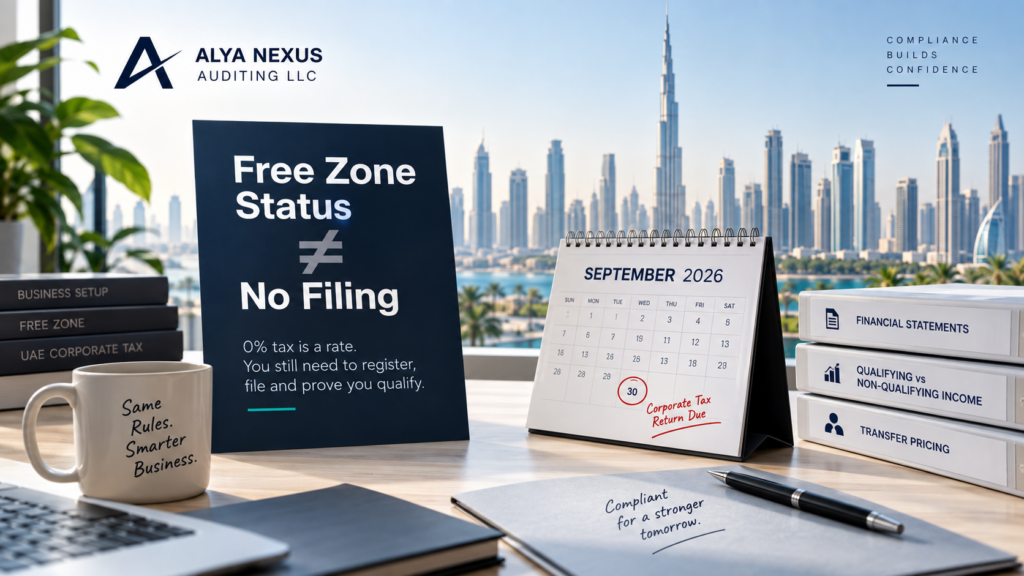
For any business with a tax period running 1 January to 31 December 2025, the Corporate Tax return and any tax payable are due nine months after year-end, which lands on September 30, 2026. This is the second filing cycle since Corporate Tax was introduced, so for most calendar-year businesses this isn’t a first-time filing, it’s a repeat obligation with less room for the “we didn’t know” explanation that carried some weight in year one.
That nine-month rule is the general standard set by the Federal Tax Authority, and it applies the same way regardless of what your Corporate Tax bill comes out to. A mainland company paying 9% and a free zone company paying 0% are working from the identical calendar.
Why 0% doesn’t mean no return
The 0% Corporate Tax rate only applies to qualifying income earned by a Qualifying Free Zone Person, and QFZP status isn’t something the FTA assumes on your behalf. It’s a position you claim and support with evidence, in the return itself. That return needs to show:
- Which income is qualifying and which isn’t, because most free zone businesses earn at least some non-qualifying income that’s taxed at the standard 9% rate
- The de minimis threshold hasn’t been breached, since non-qualifying income above a set limit relative to total revenue can disqualify the whole entity from the 0% rate for that period
- Transfer pricing documentation for related-party transactions, which has become one of the more scrutinized areas going into this filing cycle
- Audited financial statements where required, supporting everything claimed in the return
Skip the filing and none of that gets tested or recorded. You haven’t avoided the compliance step, you’ve just left your 0% position unproven on record, which is a worse position to be in if the FTA ever asks.
What happens if you miss it
The penalty structure doesn’t care that your tax bill is zero:
- AED 500 per month (or part of a month) for the first 12 months after a missed filing deadline
- AED 1,000 per month from month 13 onward, for as long as the return stays unfiled
- 14% per annum, calculated monthly, on any tax that is actually payable and unpaid, under Cabinet Decision No. 129 of 2025
For a genuinely qualifying free zone business, that third penalty may not bite since there’s little or no tax due. The first two absolutely do, and they accrue whether your return shows AED 0 or AED 2 million.
A quick check
If you can say yes to the first two of these, September 30 is your deadline:
- Your business is registered for UAE Corporate Tax
- Your financial year ended December 31, 2025
- You’re licensed in a free zone, including if you expect to pay 0%
Sole establishments, freelancers, and individual partners in free zones aren’t automatically off the hook either. If free zone turnover crossed AED 1 million during 2025, registration was already required earlier in the year, and the same filing deadline applies now.
If you’re still not sure whether your entity is even structured correctly for free zone tax treatment in the first place, that’s a step worth settling before you file, not after. We cover the practical differences in Free Zone vs Mainland: Accounting and Tax Differences Explained, including where the two get confused most often, which is exactly the confusion this deadline tends to expose.
What to do before September 30
Waiting until the last week to start is where most avoidable penalties come from, not from complicated tax positions but from running out of time to fix simple documentation gaps. For a step-by-step walkthrough, see our Corporate Tax filing checklist for the final two weeks. In short: finalize your 2025 accounts, confirm your qualifying versus non-qualifying income split, gather your related-party transaction records, and file through EmaraTax with time to spare rather than against the clock.
If you’d rather have someone confirm your QFZP position is actually defensible before it’s on record with the FTA, that’s precisely the kind of review worth doing now. Talk to Alya Auditors about your Corporate Tax filing before the deadline closes in.
FAQ
Do free zone companies really have to file a Corporate Tax return if they pay 0% tax? Yes. Registration and filing are separate obligations from the tax rate itself. A Qualifying Free Zone Person still submits a full return showing how it qualifies for the 0% rate on its qualifying income, even when the resulting tax payable is nil.
What’s the penalty for filing late as a free zone company? AED 500 per month for the first 12 months after the deadline, rising to AED 1,000 per month from month 13 onward, regardless of how much tax is actually owed. If there’s unpaid tax on top of that, a 14% per annum late payment penalty applies under Cabinet Decision No. 129 of 2025.
Is the September 30 deadline the same for mainland and free zone companies? Yes, when both have a financial year ending December 31, 2025. The nine-months-after-year-end rule applies equally; free zone status affects the tax rate, not the filing timeline.
Does this deadline apply to freelancers and sole establishments in free zones? It applies to anyone registered for Corporate Tax with a December 31, 2025 year-end. Natural persons whose free zone turnover exceeded AED 1 million during 2025 were required to register earlier in the year and are now subject to the same filing deadline.
What if my free zone company had no income at all in 2025? A return is still generally required once you’re registered, even to report nil activity. Don’t assume no income means no filing obligation; confirm your specific position before the deadline rather than after.
This article is for general information and does not replace individual tax advice. Corporate Tax positions, including Qualifying Free Zone Person status, depend on each business’s specific facts.

Keep reading

Ready to Start?
Talk to a UAE compliance expert
Book a free, no-obligation consultation with ALYA Nexus Auditing.
Book Free Consultation ↗